Yesterday saw the announcement that England half or fullback Gareth Widdop will be joining Warrington for the start of the 2020 season on a three-year deal. All of which has caused the kind of hysteria you would expect from Wolves fans who live in a perpetual state of optimism.
Irrespective of how many knocks they take Wire fans have absolute conviction that the next year will be their year. Some have a self-mocking charm about them while others are off the scale delusional. The latter group will be worse than ever when Widdop rocks up at the Haliwell Jones Stadium in a year’s time. It was almost their year in 2018 but the poor bleeders had to look on helplessly as Catalans Dragons spoiled their Challenge Cup dreams at Wembley before Wigan edged them out 12-4 in the Super League Grand Final at Old Trafford. Warrington have lost four of the last six major finals, twice losing both major finals in the same season in the last three campaigns It is never their year.
Whether he plays as a fullback, stand-off or scrum-half for Warrington Widdop is likely to be the best in his position in Super League in 2020. Yet having just spent the last 12 months witnessing Ben Barba fail to lift either the Challenge Cup or a Super League title we Saints fans can assure our Wire friends that having the best player in the competition guarantees nothing. Especially in our system in which you are required to gamble a whole season’s work on one night in October.
Before he arrives in England Widdop has the 2019 season to get through in the NRL with St.George-Illawarra. He has just had major shoulder surgery which kept him out of England’s test series with New Zealand in the autumn. The shoulder needs to hold up through the rigours of a tough campaign if he is to have the impact that we think he might. While it is great to see top NRL stars choosing to play in England without first having failed a drugs test or interfered with an animal, the idea that Widdop is Super League’s biggest ever signing is hyperbole. He’s not even the biggest name to sign for Warrington even if some Wire fans appear to have forgotten all about Alfie Langer and Andrew Johns. Others throughout Super League history like Barba, Steve Renouf, Trent Barrett and Danny Buderus were all equally if not more star-sprinkled than Widdop.
The hysteria is fuelled by the rugby league journalists. Yet it’s hard to criticise them for someone like me who spends far too much time advising them on Twitter that they should stop talking the game down. And while they’re at it stop blowing smoke up the arse of rugby union. So while it is nice to see a little rooftop-shouting from our game’s media it should come with a note of caution for Wire fans. This isn’t the most seismic thing to happen in the Super League era. No doubt Widdop will raise attendances at the Haliwell Jones and provide as many memorable moments as Barba did at Saints. In his own style. He’s not one for scoring from 90 metres while appearing to jog. But if you want playoffs as opposed to a first past the post system then you have to take on board the idea that signing Widdop doesn’t improve Warrington’s chances of breaking their finals hoodoo very much at all. They’re still Warrington. It’s probably not going to be their year.
Shuffling The Pack
It’s been a quiet winter at Saints. Much of the recruitment for the 2019 season had been done well before I was forced to hold hands and sing auld lang syne. Though not before Jools Holland recorded the hootenanny. Kevin Naiqama, Lachlan Coote and Joseph Paulo have arrived from the NRL with Joe Batchelor coming in from York City Knights. Jon Wilkin, Ben Barba and Matty Smith have all moved on while Ryan Morgan will spend the season on loan at London Broncos.
So the only business that remained was to tie up existing players on extended contracts or else offload those who may not be part of Justin Holbrook’s plans. It was persistently suggested that Kyle Amor would leave the club after four years and a Grand Final win to add to last season’s League Leaders Shield. London and Salford were touted as possible destinations for the former Wakefield man. Yet he remains, preferring to fight for his place rather than uproot his family.
Amor’s mission just got that bit more difficult as we swing around wildly to the point of this piece. Saints announced this week that they had given contract extensions to two of Amor’s direct competitors for a place in the front row. Louie McCarthy-Scarsbrook will now be a Saint until the end of 2020 while Matty Lees has signed a deal running to the end of 2021. They join Jack Ashworth, Luke Douglas and fit-again Alex Walmsley in a group of front row forwards that offers as much if not more depth than that of any other a Super League club.
Both new deals will be widely welcomed I’m sure, though it remains a mystery to me how McCarthy Scarsbrook can be entering into a deal which will see him complete 10 years at the club. The former London man managed to mention the prospect of receiving a testimonial before that of winning some more silverware with Saints, though he did regather himself enough to point out that the latter aim was the more important one. Like Amor, that 2014 double of League Leaders Shield and Grand Final are the only medals that McCarthy-Scarsbrook has collected since his debut in 2011. That he has been offered a new deal ahead of Amor is what old fashioned speakers might call much of a muchness to me. Amor might consider himself a little unfortunate. Perhaps McCarthy-Scarsbrook’s ability to operate at loose forward or as a wide running second row have got him the nod over Amor, whose approach to the defensive line with ball in hand was never reminiscent of Adrian Morley’s, but which seems to have slowed even further in recent years. McCarthy-Scarsbrook will run in harder, though in truth you’d be forgiven for thinking that the main difference between the two Irish internationals is their hairstyles. McCarthy-Scarsbrook’s histrionics, high-fives and propensity to swear in front of a camera have made him a crowd favourite, while a Amor’s unspectacular workhorse approach is less popular.
Now here’s something we can all agree on. Keeping Lees at the club for at least the next three seasons is a very good, if rather obvious move. Lees broke into the Saints first team in 2017 and became a squad regular in 2018 under Holbrook. With Walmsley injured Lees and Ashworth showed that they can be counted on to be part of the prop rotation on a regular basis in a Super League. Lees has only made 20 appearances for the first team but could become a key man in the pack in 2019 even with the return of a Walmsley and what we all hope will be the continuation of Luke Thompson’s world class form.
Lees will be 21 just a few days after Wigan come to town for the opening game of the 2019 Super a League season and alongside Thompson and Ashworth should be the future of the Saints front row. No less a figure than Saints legend Paul Sculthorpe named Lees as the best player on and off the pitch on the recent England Knights tour to Papua New Guinea. This could be the year that Lees follows Thompson and Walmsley into the full England side, especially if he can stay disciplined without losing the aggression that characterises his game. He was heavily criticised for a red card he received at Salford last term but under the guidance of Holbrook there is every reason to believe that those sorts of flaws can be eradicated from his game.
So the only business that remained was to tie up existing players on extended contracts or else offload those who may not be part of Justin Holbrook’s plans. It was persistently suggested that Kyle Amor would leave the club after four years and a Grand Final win to add to last season’s League Leaders Shield. London and Salford were touted as possible destinations for the former Wakefield man. Yet he remains, preferring to fight for his place rather than uproot his family.
Amor’s mission just got that bit more difficult as we swing around wildly to the point of this piece. Saints announced this week that they had given contract extensions to two of Amor’s direct competitors for a place in the front row. Louie McCarthy-Scarsbrook will now be a Saint until the end of 2020 while Matty Lees has signed a deal running to the end of 2021. They join Jack Ashworth, Luke Douglas and fit-again Alex Walmsley in a group of front row forwards that offers as much if not more depth than that of any other a Super League club.
Both new deals will be widely welcomed I’m sure, though it remains a mystery to me how McCarthy Scarsbrook can be entering into a deal which will see him complete 10 years at the club. The former London man managed to mention the prospect of receiving a testimonial before that of winning some more silverware with Saints, though he did regather himself enough to point out that the latter aim was the more important one. Like Amor, that 2014 double of League Leaders Shield and Grand Final are the only medals that McCarthy-Scarsbrook has collected since his debut in 2011. That he has been offered a new deal ahead of Amor is what old fashioned speakers might call much of a muchness to me. Amor might consider himself a little unfortunate. Perhaps McCarthy-Scarsbrook’s ability to operate at loose forward or as a wide running second row have got him the nod over Amor, whose approach to the defensive line with ball in hand was never reminiscent of Adrian Morley’s, but which seems to have slowed even further in recent years. McCarthy-Scarsbrook will run in harder, though in truth you’d be forgiven for thinking that the main difference between the two Irish internationals is their hairstyles. McCarthy-Scarsbrook’s histrionics, high-fives and propensity to swear in front of a camera have made him a crowd favourite, while a Amor’s unspectacular workhorse approach is less popular.
Now here’s something we can all agree on. Keeping Lees at the club for at least the next three seasons is a very good, if rather obvious move. Lees broke into the Saints first team in 2017 and became a squad regular in 2018 under Holbrook. With Walmsley injured Lees and Ashworth showed that they can be counted on to be part of the prop rotation on a regular basis in a Super League. Lees has only made 20 appearances for the first team but could become a key man in the pack in 2019 even with the return of a Walmsley and what we all hope will be the continuation of Luke Thompson’s world class form.
Lees will be 21 just a few days after Wigan come to town for the opening game of the 2019 Super a League season and alongside Thompson and Ashworth should be the future of the Saints front row. No less a figure than Saints legend Paul Sculthorpe named Lees as the best player on and off the pitch on the recent England Knights tour to Papua New Guinea. This could be the year that Lees follows Thompson and Walmsley into the full England side, especially if he can stay disciplined without losing the aggression that characterises his game. He was heavily criticised for a red card he received at Salford last term but under the guidance of Holbrook there is every reason to believe that those sorts of flaws can be eradicated from his game.
Great Saints Moments - 2014 Super League Title
For the majority of rugby league clubs, even those in the Super League, four years is not a particularly long time between championships. Yet as we crashed out to Warrington in the race to Old Trafford on that early October night in 2018 it began to feel like our 2014 Grand Final victory was a lifetime ago.
Nine weeks on from that 18-13 defeat to a Warrington side we all knew full well would bottle it against Wigan in the big one the wait for that title now feels interminable. So to numb the pain of it just that little bit before Wigan come to town for the first match of our 2019 campaign on January 31 let’s look back on our last success and in particular, one glorious moment from it.
In 2014 Nathan Brown was entering his second and what would turn out to be his final season as Head Coach at Saints. His first had been a difficult one, Saints finishing fifth in the table before crashing out in the second round of what was then a gruelling four-week playoff series by just a single point to Leeds Rhinos. If that system seemed taxing, the powers that be compounded the problems by expanding the number of playoff teams to eight for 2014 and declaring that the highest ranked winner from the first week of the playoffs would then be able to select its semi-final opponent after a week off. ‘Club Cal’l they called it, which evoked memories of premium rate phone-lines specifically set up to rip off football fans desperate for news about their team in the days before the internet. So even the name wasn’t new. They called it innovative. On a scale of one to ten it was batshit crazy.
To boost his squad Brown had brought in scrum-half Luke Walsh from Penrith Panthers. The same club provided Mose Masoe, a giant of a prop-forward with equally mountainous hair. Mose became a cult hero with some fans on the basis that he wasn’t frightened of Micky McIlorum, but his all-around contribution was questionable. There were times when he would have five minute stints in which he would not carry the ball once, almost as if he had been thrown in there to intimidate but not actually be used, the nuclear deterrent of rugby league. More promising was Kyle Amor, brought in on a four-year deal from Wakefield Trinity Wildcats after starting out at Leeds Rhinos. Matty Dawson was a three-quarter who had worked with Brown before at Huddersfield Giants while Richard Beaumont represented something of a gamble from Hull KR. The then 26-year-old prop had played for Rovers in Super League in 2011 but ended up on loan to Gateshead in 2013 from where he joined Saints. He never made a first team appearance for the Red Vee.
Six players left Saints ahead of the 2014 season, with once-prolific if accident prone three-quarter Francis Meli joining Salford along with prop/second row Tony Puletua, while locally-produced halfback Lee Gaskell found his way to Bradford. Josh Perry, who had joined Saints with a big reputation as a one-time State Of Origin and Australian Test forward, retired after a string of injuries limited him to 44 underwhelming appearances in three seasons. Youngsters Dom Speakman and Nathan Ashe also headed for the exit before the opening game of the 2014 campaign at Warrington on February 13.
Walsh starred in that game, and it looked at last as though Saints had found a half who could adequately fill the boots of the great Sean Long. Walsh conducted the orchestra beautifully, scoring himself and kicking seven goals from seven attempts. Amor got a try on his Saints Super League debut and there were others for Adam Swift, Anthony Laffranchi, Tommy Makinson and James Roby. Warrington could only reply with a brace from Joel Monaghan as Saints ran out 38-8 winners at the Halliwell Jones Stadium. They had laid down a marker.
Their good form continued as they won their first eight league games and knocked Huddersfield out of the Challenge Cup at the John Smith’s Stadium thanks to a Walsh drop-goal. Defeat was only tasted on Good Friday when a Sam Tomkins-led Wigan came to Langtree Park and left with a 33-14 triumph. It was the first of three defeats in a row as the ship began to list a little. The third loss in that run saw them ousted from the Challenge Cup by Leeds Rhinos, going down 32-12 at Headingley. Brown was having trouble finding a suitable halfback partner for Walsh, pressing Jon Wilkin into action there having lost Gary Wheeler through injury. He’d also tried Paul Wellens who at 34 had been removed from his fullback position by Jonny Lomax. When Lomax wasn’t available Lance Hohaia took the berth, while the New Zealand World Cup-winner had also been among those who Brown had tried to pair up with Walsh in the halves.
Wins against the league’s whipping boys London and Bradford followed the Leeds defeat but there was other setback on May 18 when Saints travelled to Manchester’s Etihad Stadium for the Magic Weekend clash with Warrington. They were handed a 41-24 defeat by Tony Smith’s side. Monaghan scored twice more while Rhys Evans added a brace of his own to add to efforts from Ryan Atkins, Chris Hill, Gene Ormsby and Matty Russell. Dawson, Hohaia, Jordan Turner and Alex Walmsley crossed for Saints while Walsh kicked four goals. Yet by now Saints early season form had turned decidedly flakey. They were thrashed 42-0 by Catalans Dragons in Perpignan on June 14 and walloped 40-10 by Hull KR at KC Lightstream just three weeks later. A gentle run against Bradford, London and Widnes kept Brown’s side in the running for the League Leaders Shield and it was Castleford Tigers, rather than the traditional powerhouses of Wigan or Leeds who seemed to be offering the greatest challenge. However, that Widnes win came at a cost and would complicate Brown’s problems at halfback even further. Walsh suffered an horrific double ankle break which would keep him out of action until the following April. In fact he was never quite the player who had impressed so much in the early part of his first season at Saints. He always seemed reluctant to take on the line after the injury and though he stuck around until the end of the 2016 season he was moved on to Catalans Dragons before retiring a month before his 31st birthday. He had made only 32 appearances in two seasons for the Dragons.
Despite losing three of their last five regular season games against Hull FC, Warrington (again) and Huddersfield who gained revenge for that cup defeat by winning the league encounter by exactly the same score (17-16) the Walsh-less Saints limped over the line to collect the League Leaders Shield as Castleford failed to beat Catalans in their final game. The top four had been a close run affair to the extent that that loss meant that Castleford, the last team to be ruled out of the race for the Shield would end up finishing fourth and provide Saints first opponents in the playoff series.
Come play-off time Daryl Powell’s side were burned out. They were hammered 41-0 at Langtree Park. Saints scored seven unanswered tries with Roby grabbing a couple and Amor, Makinson, Masoe Swift and Turner also crossing. In Walsh’s absence Mark Percival had become the first choice goal-kicker and landed six shots as Saints ran out 41-0 winners. Castleford were a coming force but this was not quite their time.
Saints moved on to face the Dragons in the semi-final. The Dragons had scraped into the playoffs in seventh place having won 14 and lost 12 of their 27 regular season games with one draw. That a team with that kind of record found themselves in a semi-final shone a light on the folly of the system but they had beaten both Leeds and Huddersfield in the finals series to earn themselves a crack at the League Leaders. They held their own in the first half, trailing only 12-6 at the break but Saints ran out 30-12 winners despite the fact that their injury problems now meant that they were using former Wests and Wigan utility forward Mark Flanagan as a scrum-half. It would never work at Old Trafford, where defending champions Wigan sought a third title in four years.
Saints stuttering second half of 2014 had almost let Wigan in to steal the League Leaders Shield from their grasp. Shock defeats to Bradford and Widnes in the last month of the regular season kiboshed those ambitions for Shaun Wane’s men but they were coming into the Old Trafford Grand Final on the back of four consecutive wins. Leeds and Warrington had been their last two regular season victims as they fell just a point short of Saints at the top of the table, while a 57-4 shellacking of Huddersfield in the first play-off round was followed by a thrilling 16-12 semi-final win over Warrington at the DW Stadium. With Walsh, Wilkin, Lomax and of course Wheeler all injured a Wigan side containing Josh Charnley, Anthony Gelling, Joe Burgess, Blake Green, Matty Smith and Sean O’Loughlin were heavily fancied. Even if they did have to carry Eddie Pettybourne.
It took just two minutes for the bookmakers to start frantically adjusting the odds on the destination of the Super League trophy. As Wigan launched an early attack on the Saints line Green sent a crossfield bomb arching towards Tommy Makinson. The winger flapped at the ball and Wigan regained possession. It was still the last tackle and things became a little frantic, with Wigan looking to keep the ball alive. Behind the play Ben Flower and Hohaia clashed. Soon, all the players on both side were coming together in a bout of push and shove. Hohaia lay prostrate on the ground as the Saints physios attempted to tend to him. Watching from inside the ground but at the other end of the stadium I hadn’t seen what had transpired between Flower and Hohaia. The presence of big screen replays at rugby league is something I never tire of criticising, but it certainly added to the experience in this one. Along with the tens of thousands of other fans on both sides I watched open mouthed as the evidence showed not only that Flower had landed a knockout blow on Hohaia, but that he had then crouched down over his stricken victim and planted another hammer blow into his face. Hohaia was already unconscious. It was the most sickening thing I have seen on a sports field and led to red card and a six-month hiatus from the game for the Welsh forward. It should have been longer. He should never have played again. Six months sounds like a lot but this was the last game of the season and there would be nothing for another three or four months. In reality Flower missed 10 games, the most preposterous non-punishment since Harold Schumacher in ’82.

If the fans, who are hardly the best of friends anyway, were not up for it at the beginning the Flower/Hohaia incident lit the torch. The atmosphere was raucous, bordering on sinister the rest of the way. We felt a real injustice at the way we had lost one of the few players we still had who could play in the halves while they revelled in their shithousery. Even for Wigan the Flower crime was outrageous. Yet the Wigan fans surrounding my place in the stands had the temerity to cast Flower as the victim of the injustice. Hohaia had struck first, they protested, as if that warranted the reaction from Flower.
Our anger simmered when Wigan took the lead through Burgess. The ball was shifted to the left wing by Smith via Green before Burgess squeezed in at the left hand corner. There were only seconds to go to half-time and although Smith’s conversion failed it meant that the Warriors would go to the break with a 6-2 lead. Yet just 13 minutes into the second half Saints were back in it. Roby moved into his familiar dummy half position with Saints close to the line before feeding Sia Soliola who crashed through the defenders to score Saints first try of the night. Soliola was playing his last game for Saints after a five-year spell. He would be joining Canberra Raiders in the NRL for 2015 and beyond and had possibly handed Saints the ideal leaving gift.
Three minutes later, with Saints now leading 8-6 following Soliola’s score, Makinson made the first of two hugely telling contributions to proceedings. Liam Farrell made a powerful break on the left hand channel and was suddenly faced with only Makinson to beat. However, the man recently named 2018 Golden Boot winner, filling in at full-back after Wellens had switched to the halves to replace Hohaia, got his angles spot on before executing the perfect cover tackle on the England second rower. Even at that point, playing against 12-men and just ahead on the scoreboard, it felt like a defining moment in this Grand Final. Yet Makinson wasn’t finished with defining moments of this Grand Final.
Less than 12 minutes remained when Saints worked the ball to the right wing on the last tackle. The ball found Wellens who by now was popping up everywhere. In this instance he was out on the right edge. Not that his positioning at that moment caused him to forget any of his halfback skills. Wellens had burst into the Saints team as an 18-year-old halfback back in 1998 and showed that he had lost none of that game intelligence with a towering kick back across to the centre of the field but close to the Wigan line. Makinson soared above the Wigan defence, timing his leap to absolute perfection before clutching the ball out of the air and plonking it down over the line in one glorious, Wigan-repelling movement. The try sparked wild celebrations, including from certain members of the broadcasting crew who failed miserably to hide their allegiances. Percival’s conversion sewed up the win. There were only eight points between the sides but in a game this tight, and with one man less on the field, Wigan never really looked likely to get the two scores they needed in the time that remained. Smith had missed a relatively simple penalty shot earlier on which, had he landed it, might just have been the spur his side needed to push for another score to tie the game, but with a two-score deficit there was no way back. Saints were champions for the first time in eight years, almost wiping away the pain of five consecutive Grand Final defeats during that spell. Wellens fell to his knees in a mixture of joy, relief and fatigue. It would be his last title with Saints as he retired in 2015.
The hope is that it won’t be Makinson’s last with Saints. His performances with England in the Test series with New Zealand have not only earned him the Golden Boot but also alerted several NRL clubs to his presence. It is widely thought that he might fancy a crack at the Australian competition once his Saints contract runs out. If he does, we will be losing one of the finest wingers in the world, a man who crossed for 29 tries in that last title season of 2014. But we’ll always have the memory of his flight above the Wigan defence and the spectacular touchdown that followed.
Nine weeks on from that 18-13 defeat to a Warrington side we all knew full well would bottle it against Wigan in the big one the wait for that title now feels interminable. So to numb the pain of it just that little bit before Wigan come to town for the first match of our 2019 campaign on January 31 let’s look back on our last success and in particular, one glorious moment from it.
In 2014 Nathan Brown was entering his second and what would turn out to be his final season as Head Coach at Saints. His first had been a difficult one, Saints finishing fifth in the table before crashing out in the second round of what was then a gruelling four-week playoff series by just a single point to Leeds Rhinos. If that system seemed taxing, the powers that be compounded the problems by expanding the number of playoff teams to eight for 2014 and declaring that the highest ranked winner from the first week of the playoffs would then be able to select its semi-final opponent after a week off. ‘Club Cal’l they called it, which evoked memories of premium rate phone-lines specifically set up to rip off football fans desperate for news about their team in the days before the internet. So even the name wasn’t new. They called it innovative. On a scale of one to ten it was batshit crazy.
To boost his squad Brown had brought in scrum-half Luke Walsh from Penrith Panthers. The same club provided Mose Masoe, a giant of a prop-forward with equally mountainous hair. Mose became a cult hero with some fans on the basis that he wasn’t frightened of Micky McIlorum, but his all-around contribution was questionable. There were times when he would have five minute stints in which he would not carry the ball once, almost as if he had been thrown in there to intimidate but not actually be used, the nuclear deterrent of rugby league. More promising was Kyle Amor, brought in on a four-year deal from Wakefield Trinity Wildcats after starting out at Leeds Rhinos. Matty Dawson was a three-quarter who had worked with Brown before at Huddersfield Giants while Richard Beaumont represented something of a gamble from Hull KR. The then 26-year-old prop had played for Rovers in Super League in 2011 but ended up on loan to Gateshead in 2013 from where he joined Saints. He never made a first team appearance for the Red Vee.
Six players left Saints ahead of the 2014 season, with once-prolific if accident prone three-quarter Francis Meli joining Salford along with prop/second row Tony Puletua, while locally-produced halfback Lee Gaskell found his way to Bradford. Josh Perry, who had joined Saints with a big reputation as a one-time State Of Origin and Australian Test forward, retired after a string of injuries limited him to 44 underwhelming appearances in three seasons. Youngsters Dom Speakman and Nathan Ashe also headed for the exit before the opening game of the 2014 campaign at Warrington on February 13.
Walsh starred in that game, and it looked at last as though Saints had found a half who could adequately fill the boots of the great Sean Long. Walsh conducted the orchestra beautifully, scoring himself and kicking seven goals from seven attempts. Amor got a try on his Saints Super League debut and there were others for Adam Swift, Anthony Laffranchi, Tommy Makinson and James Roby. Warrington could only reply with a brace from Joel Monaghan as Saints ran out 38-8 winners at the Halliwell Jones Stadium. They had laid down a marker.
Their good form continued as they won their first eight league games and knocked Huddersfield out of the Challenge Cup at the John Smith’s Stadium thanks to a Walsh drop-goal. Defeat was only tasted on Good Friday when a Sam Tomkins-led Wigan came to Langtree Park and left with a 33-14 triumph. It was the first of three defeats in a row as the ship began to list a little. The third loss in that run saw them ousted from the Challenge Cup by Leeds Rhinos, going down 32-12 at Headingley. Brown was having trouble finding a suitable halfback partner for Walsh, pressing Jon Wilkin into action there having lost Gary Wheeler through injury. He’d also tried Paul Wellens who at 34 had been removed from his fullback position by Jonny Lomax. When Lomax wasn’t available Lance Hohaia took the berth, while the New Zealand World Cup-winner had also been among those who Brown had tried to pair up with Walsh in the halves.
Wins against the league’s whipping boys London and Bradford followed the Leeds defeat but there was other setback on May 18 when Saints travelled to Manchester’s Etihad Stadium for the Magic Weekend clash with Warrington. They were handed a 41-24 defeat by Tony Smith’s side. Monaghan scored twice more while Rhys Evans added a brace of his own to add to efforts from Ryan Atkins, Chris Hill, Gene Ormsby and Matty Russell. Dawson, Hohaia, Jordan Turner and Alex Walmsley crossed for Saints while Walsh kicked four goals. Yet by now Saints early season form had turned decidedly flakey. They were thrashed 42-0 by Catalans Dragons in Perpignan on June 14 and walloped 40-10 by Hull KR at KC Lightstream just three weeks later. A gentle run against Bradford, London and Widnes kept Brown’s side in the running for the League Leaders Shield and it was Castleford Tigers, rather than the traditional powerhouses of Wigan or Leeds who seemed to be offering the greatest challenge. However, that Widnes win came at a cost and would complicate Brown’s problems at halfback even further. Walsh suffered an horrific double ankle break which would keep him out of action until the following April. In fact he was never quite the player who had impressed so much in the early part of his first season at Saints. He always seemed reluctant to take on the line after the injury and though he stuck around until the end of the 2016 season he was moved on to Catalans Dragons before retiring a month before his 31st birthday. He had made only 32 appearances in two seasons for the Dragons.
Despite losing three of their last five regular season games against Hull FC, Warrington (again) and Huddersfield who gained revenge for that cup defeat by winning the league encounter by exactly the same score (17-16) the Walsh-less Saints limped over the line to collect the League Leaders Shield as Castleford failed to beat Catalans in their final game. The top four had been a close run affair to the extent that that loss meant that Castleford, the last team to be ruled out of the race for the Shield would end up finishing fourth and provide Saints first opponents in the playoff series.
Come play-off time Daryl Powell’s side were burned out. They were hammered 41-0 at Langtree Park. Saints scored seven unanswered tries with Roby grabbing a couple and Amor, Makinson, Masoe Swift and Turner also crossing. In Walsh’s absence Mark Percival had become the first choice goal-kicker and landed six shots as Saints ran out 41-0 winners. Castleford were a coming force but this was not quite their time.
Saints moved on to face the Dragons in the semi-final. The Dragons had scraped into the playoffs in seventh place having won 14 and lost 12 of their 27 regular season games with one draw. That a team with that kind of record found themselves in a semi-final shone a light on the folly of the system but they had beaten both Leeds and Huddersfield in the finals series to earn themselves a crack at the League Leaders. They held their own in the first half, trailing only 12-6 at the break but Saints ran out 30-12 winners despite the fact that their injury problems now meant that they were using former Wests and Wigan utility forward Mark Flanagan as a scrum-half. It would never work at Old Trafford, where defending champions Wigan sought a third title in four years.
Saints stuttering second half of 2014 had almost let Wigan in to steal the League Leaders Shield from their grasp. Shock defeats to Bradford and Widnes in the last month of the regular season kiboshed those ambitions for Shaun Wane’s men but they were coming into the Old Trafford Grand Final on the back of four consecutive wins. Leeds and Warrington had been their last two regular season victims as they fell just a point short of Saints at the top of the table, while a 57-4 shellacking of Huddersfield in the first play-off round was followed by a thrilling 16-12 semi-final win over Warrington at the DW Stadium. With Walsh, Wilkin, Lomax and of course Wheeler all injured a Wigan side containing Josh Charnley, Anthony Gelling, Joe Burgess, Blake Green, Matty Smith and Sean O’Loughlin were heavily fancied. Even if they did have to carry Eddie Pettybourne.
It took just two minutes for the bookmakers to start frantically adjusting the odds on the destination of the Super League trophy. As Wigan launched an early attack on the Saints line Green sent a crossfield bomb arching towards Tommy Makinson. The winger flapped at the ball and Wigan regained possession. It was still the last tackle and things became a little frantic, with Wigan looking to keep the ball alive. Behind the play Ben Flower and Hohaia clashed. Soon, all the players on both side were coming together in a bout of push and shove. Hohaia lay prostrate on the ground as the Saints physios attempted to tend to him. Watching from inside the ground but at the other end of the stadium I hadn’t seen what had transpired between Flower and Hohaia. The presence of big screen replays at rugby league is something I never tire of criticising, but it certainly added to the experience in this one. Along with the tens of thousands of other fans on both sides I watched open mouthed as the evidence showed not only that Flower had landed a knockout blow on Hohaia, but that he had then crouched down over his stricken victim and planted another hammer blow into his face. Hohaia was already unconscious. It was the most sickening thing I have seen on a sports field and led to red card and a six-month hiatus from the game for the Welsh forward. It should have been longer. He should never have played again. Six months sounds like a lot but this was the last game of the season and there would be nothing for another three or four months. In reality Flower missed 10 games, the most preposterous non-punishment since Harold Schumacher in ’82.
If the fans, who are hardly the best of friends anyway, were not up for it at the beginning the Flower/Hohaia incident lit the torch. The atmosphere was raucous, bordering on sinister the rest of the way. We felt a real injustice at the way we had lost one of the few players we still had who could play in the halves while they revelled in their shithousery. Even for Wigan the Flower crime was outrageous. Yet the Wigan fans surrounding my place in the stands had the temerity to cast Flower as the victim of the injustice. Hohaia had struck first, they protested, as if that warranted the reaction from Flower.
Our anger simmered when Wigan took the lead through Burgess. The ball was shifted to the left wing by Smith via Green before Burgess squeezed in at the left hand corner. There were only seconds to go to half-time and although Smith’s conversion failed it meant that the Warriors would go to the break with a 6-2 lead. Yet just 13 minutes into the second half Saints were back in it. Roby moved into his familiar dummy half position with Saints close to the line before feeding Sia Soliola who crashed through the defenders to score Saints first try of the night. Soliola was playing his last game for Saints after a five-year spell. He would be joining Canberra Raiders in the NRL for 2015 and beyond and had possibly handed Saints the ideal leaving gift.
Three minutes later, with Saints now leading 8-6 following Soliola’s score, Makinson made the first of two hugely telling contributions to proceedings. Liam Farrell made a powerful break on the left hand channel and was suddenly faced with only Makinson to beat. However, the man recently named 2018 Golden Boot winner, filling in at full-back after Wellens had switched to the halves to replace Hohaia, got his angles spot on before executing the perfect cover tackle on the England second rower. Even at that point, playing against 12-men and just ahead on the scoreboard, it felt like a defining moment in this Grand Final. Yet Makinson wasn’t finished with defining moments of this Grand Final.
Less than 12 minutes remained when Saints worked the ball to the right wing on the last tackle. The ball found Wellens who by now was popping up everywhere. In this instance he was out on the right edge. Not that his positioning at that moment caused him to forget any of his halfback skills. Wellens had burst into the Saints team as an 18-year-old halfback back in 1998 and showed that he had lost none of that game intelligence with a towering kick back across to the centre of the field but close to the Wigan line. Makinson soared above the Wigan defence, timing his leap to absolute perfection before clutching the ball out of the air and plonking it down over the line in one glorious, Wigan-repelling movement. The try sparked wild celebrations, including from certain members of the broadcasting crew who failed miserably to hide their allegiances. Percival’s conversion sewed up the win. There were only eight points between the sides but in a game this tight, and with one man less on the field, Wigan never really looked likely to get the two scores they needed in the time that remained. Smith had missed a relatively simple penalty shot earlier on which, had he landed it, might just have been the spur his side needed to push for another score to tie the game, but with a two-score deficit there was no way back. Saints were champions for the first time in eight years, almost wiping away the pain of five consecutive Grand Final defeats during that spell. Wellens fell to his knees in a mixture of joy, relief and fatigue. It would be his last title with Saints as he retired in 2015.
The hope is that it won’t be Makinson’s last with Saints. His performances with England in the Test series with New Zealand have not only earned him the Golden Boot but also alerted several NRL clubs to his presence. It is widely thought that he might fancy a crack at the Australian competition once his Saints contract runs out. If he does, we will be losing one of the finest wingers in the world, a man who crossed for 29 tries in that last title season of 2014. But we’ll always have the memory of his flight above the Wigan defence and the spectacular touchdown that followed.
Will Saints Miss Ryan Morgan?
Saints 2019 squad is one player lighter today after Ryan Morgan joined London Broncos on loan. The Australian centre heads to the capital on a season-long deal after spending two seasons with Saints.
Initial reaction from the fans suggest he won't be missed. With Kevin Naiqama arriving from Wests Tigers this week there had to have been some doubt about how much first team action Morgan would have seen had he stayed. Announcing the move Saints Grand Fromage Mike Rush alluded to that by seeming to confirm that Naiqama is here to play as a centre. That was always the likeliest scenario despite some speculation that the Fijian captain could fit in at either fullback or wing. All of which may have left Morgan to fill the Matty Smith role of highly paid star on the sidelines.
Be that as it may we may yet have reason to lament Morgan's exit. Nobody quite knows how the Naiqama signing will work out. His quality is not in question but there's always an element of risk in bringing in NRL stars with big reputations. For every Ben Barba there's a Josh Perry. We need Naiqama to hit the ground running and, perhaps more importantly, stay healthy to ensure that he becomes the upgrade on Morgan that we hope and expect he will be.
Another worry is the dark mutterings coming from social media about the future of Tommy Makinson. The England man has just won the Golden Boot as the international player of the year and was perhaps the key man for Wayne Bennett's side in the recent 2-1 series victory over New Zealand. His recent admission that he would one day like to try his luck in the NRL has got the cogs whirring among the rumour-fanciers. It is believed he is still in Australia with some suggesting that he will not return without an NRL deal in his back pocket. Makinson has this coming season remaining on his contract and may well honour that. He will still only be 28 at the start of the 2020 season which still leaves him potentially at his peak for a tilt at the best league in the sport. But might a player who has already suffered two serious knee injuries in his career want to strike while his proverbial iron is hot? Brad Fittler might not have heard of Makinson but you can rest assured that those in charge of recruitment at NRL clubs will be a touch more enlightened. His performances for Engand will not have gone unnoticed and it will be a surprise if he hasn't had at least tentative offers.
The decision to allow Morgan to depart could leave Saints vulnerable if injuries hit. That would only be exacerbated should Makinson find the lure of the NRL too strong. Adam Swift and Regan Grace offer depth on the wings but if there are any problems with Naiqama or Mark Percival then there isn't the same level of talent at centre. Matty Costello has let nobody down in his young career but he still represents a significant step down in class from Saints other options, including Morgan.
Morgan is an under-rated, often under-appreciated performer. Many fans haven't forgiven him for his brain explosion in the Super League semi-final at Castleford last year. Having crossed for what looked to be the winning score in the final minutes Morgan gave away a needless penalty for obstructing Michael Shenton as the pair chased a kick towards the Saints try line that neither was ever going to reach. Some fans wanted Morgan out there and then as Saints went on to lose to Luke Gale's extra-time drop-goal. Some of the abuse he received was puerile at best and vile at worst.
Yet the former Melbourne Storm man is a defensively reliable centre whose attacking instincts have often been curbed by the imbalance of the Saints attack. Much of the good attacking ball seems to arrive on their left edge with Morgan and Makinson often reduced to scraps served up on last tackle kicking plays. Meanwhile, we saw in the Super 8s defeat to Wigan in August how much Morgan's defensive qualities can be missed. Morgan left that game in the first half with one of a series of concussions which plagued him throughout 2018. When he did Wigan continually attacked the space he had left down the right edge of Saints defence. It was a key to a result which further highlighted Saints vulnerability to others. By the time Warrington edged Justin Holbrook's men in the semi-final it barely qualified as a surprise.
Morgan probably won't pull up too many trees in London. He's not a difference maker by himself and you probably won't find him topping the try-scoring charts in 2019. The Broncos could struggle and if they do there will be those who will use that to support the belief that Morgan isn't good enough for a Super League contender like Saints. But I can't help but think that Holbrook's side would be in a stronger position to contend with Morgan than without him.
Initial reaction from the fans suggest he won't be missed. With Kevin Naiqama arriving from Wests Tigers this week there had to have been some doubt about how much first team action Morgan would have seen had he stayed. Announcing the move Saints Grand Fromage Mike Rush alluded to that by seeming to confirm that Naiqama is here to play as a centre. That was always the likeliest scenario despite some speculation that the Fijian captain could fit in at either fullback or wing. All of which may have left Morgan to fill the Matty Smith role of highly paid star on the sidelines.
Be that as it may we may yet have reason to lament Morgan's exit. Nobody quite knows how the Naiqama signing will work out. His quality is not in question but there's always an element of risk in bringing in NRL stars with big reputations. For every Ben Barba there's a Josh Perry. We need Naiqama to hit the ground running and, perhaps more importantly, stay healthy to ensure that he becomes the upgrade on Morgan that we hope and expect he will be.
Another worry is the dark mutterings coming from social media about the future of Tommy Makinson. The England man has just won the Golden Boot as the international player of the year and was perhaps the key man for Wayne Bennett's side in the recent 2-1 series victory over New Zealand. His recent admission that he would one day like to try his luck in the NRL has got the cogs whirring among the rumour-fanciers. It is believed he is still in Australia with some suggesting that he will not return without an NRL deal in his back pocket. Makinson has this coming season remaining on his contract and may well honour that. He will still only be 28 at the start of the 2020 season which still leaves him potentially at his peak for a tilt at the best league in the sport. But might a player who has already suffered two serious knee injuries in his career want to strike while his proverbial iron is hot? Brad Fittler might not have heard of Makinson but you can rest assured that those in charge of recruitment at NRL clubs will be a touch more enlightened. His performances for Engand will not have gone unnoticed and it will be a surprise if he hasn't had at least tentative offers.
The decision to allow Morgan to depart could leave Saints vulnerable if injuries hit. That would only be exacerbated should Makinson find the lure of the NRL too strong. Adam Swift and Regan Grace offer depth on the wings but if there are any problems with Naiqama or Mark Percival then there isn't the same level of talent at centre. Matty Costello has let nobody down in his young career but he still represents a significant step down in class from Saints other options, including Morgan.
Morgan is an under-rated, often under-appreciated performer. Many fans haven't forgiven him for his brain explosion in the Super League semi-final at Castleford last year. Having crossed for what looked to be the winning score in the final minutes Morgan gave away a needless penalty for obstructing Michael Shenton as the pair chased a kick towards the Saints try line that neither was ever going to reach. Some fans wanted Morgan out there and then as Saints went on to lose to Luke Gale's extra-time drop-goal. Some of the abuse he received was puerile at best and vile at worst.
Yet the former Melbourne Storm man is a defensively reliable centre whose attacking instincts have often been curbed by the imbalance of the Saints attack. Much of the good attacking ball seems to arrive on their left edge with Morgan and Makinson often reduced to scraps served up on last tackle kicking plays. Meanwhile, we saw in the Super 8s defeat to Wigan in August how much Morgan's defensive qualities can be missed. Morgan left that game in the first half with one of a series of concussions which plagued him throughout 2018. When he did Wigan continually attacked the space he had left down the right edge of Saints defence. It was a key to a result which further highlighted Saints vulnerability to others. By the time Warrington edged Justin Holbrook's men in the semi-final it barely qualified as a surprise.
Morgan probably won't pull up too many trees in London. He's not a difference maker by himself and you probably won't find him topping the try-scoring charts in 2019. The Broncos could struggle and if they do there will be those who will use that to support the belief that Morgan isn't good enough for a Super League contender like Saints. But I can't help but think that Holbrook's side would be in a stronger position to contend with Morgan than without him.
What's The (Golden) Point?
If you surveyed rugby league fans who have been watching the game for any length of time you would probably find that the vast majority agree that the on-field product needed a shake-up. Nowhere outside the Sky Sports commentary box is the game still considered the spectacle that it was perhaps 10 or 15 years ago. We’re waking up from a slumber. At a certain point rugby league decided it was the most entertaining sport in the world and began resting lazily upon its laurels. It became perceived wisdom that the game was the most entertaining of any sport around, something we just told ourselves without ever looking inward and asking ‘are we really all that?’
Yet the need to win in the professional era had stealthily brought about a change in approach. Teams were winning ugly, five-drives-and-a-kick-ing their way to the playoffs and Grand Final. Defensively cynicism had also crept in, with the ability to wrestle valued at least alongside if not above the ability to tackle. Now, with Super League having gained some direction with the appointment of Robert Elstone as CEO, it is setting about addressing some of these issues with the announcement of at least one rule change, with more set to be ratified by the clubs in due course.
Let’s be clear, we are talking about the way the game is played here, the aesthetic value of it to the viewer. There is nothing too much wrong with it from a competitive standpoint even if the 2018 regular season was largely dominated by Saints and the identity of the top four playoff teams was revealed weeks before the Super 8s met its end. Generally in recent years the salary cap has evened out the competition, even if it has done so by dragging down the standards of the top clubs rather than raising those of the bottom clubs. Now any game can be won by either team involved on any given day in Super League. The cream generally rises to the top come the business end of the season but largely results are unpredictable. An influx of some surprisingly high quality NRL talent looks set to make 2019 even more competitive with most clubs making significant recruitment moves. It’s how we arrive at that unpredictability, the journey from minute one to 80, that needs further examination.
So in their wisdom, to try to manufacture a little more excitement to proceedings the Super League’s first measure is to introduce Golden Point extra time for drawn games. From 2019 if the scores are level at the end of 80 minutes of any Super League regular season game there will be two five-minute periods of extra time played, with the first team to score any point be it a drop-goal, penalty goal or try declared the winner. If at the end of the two five-minute periods the scores are still level the game will be declared a draw and the teams will receive one point each.
It’s interesting that the decision to introduce Golden Point, which has been in use in the NRL since 2003, comes at a time when Super League has also decided to automatically relegate the team that finishes bottom of the table at the end of the season. It is possible that a club could be relegated having lost a vital point during the extra period. A point that they had worked hard for 80 minutes for and which previously would have been a fair reward for their efforts. It has been suggested that teams keep their point for drawn games and play for an extra one in the Golden Point period, but doesn’t that afford an opportunity to a team to win a game that over 80 minutes they haven’t justified with their performance? Why should that team get more time to find a winning play? Just as it might be unfair to take a point away from a team after 80 minutes, so it might be to allow extra time to secure a second. Only four games were drawn in all of Super League last season so admittedly the odds are long on Golden Point being required in a game and perhaps even longer on it influencing the relegation issue or even a playoff issue should that extra point see a side jump from say sixth to fifth, but it is fair to run that risk?
If the risk seems unfair the rules around Golden Point within the context of a single game also seem a bit squiffy. As things stand and unless Super League make a subsequent announcement to suggest otherwise, the team receiving the ball from the extra-time kick-off must have a significant advantage. They only need to gain around 50 metres from their set of six to get close enough to have a shot at the drop-goal and should they make it there will be no opportunity for the other team to respond. The NFL amended their system in 2012 so that both teams have at least one possession in the extra period unless one side or the other scores a touchdown. If we must go down the Golden Point route then this seems a fairer approach. If a team is good enough to receive the opening kick-off and go all the way down the field for a try in their first set then maybe you say well done and accept the result. Maybe. But if all they have done is plod their way downfield for a drop-goal it doesn’t convince you that they have proved themselves superior on the day.
Does Golden Point add to the spectacle in any case? Currently the system is only in place in the UK for knockout games in either the Super League playoffs, Grand Final or the Challenge Cup. That is logistically sensible because replays are impossible given the already packed schedule and the issues around player welfare. And in that scenario it does add excitement as fans destroy their fingernails and use up every ounce of good will from whatever God they worship to try to will their team through to the next stage of a competition. But I’d argue that it adds nothing to the aesthetic beauty of the game. Fully aware that the easiest way to register the winning point is a drop-goal, teams spend all of extra-time methodically trundling their way down the field to set up the position for the one-pointer. And that after in all likelihood spending the final 10 minutes of normal time in a similar mode as they attempt to break the tie that has them heading to extra time in the first place. The game becomes a risk-free drop-goal contest with little or no room for any expansive rugby. Largely, it becomes rugby union.

Another issue for many fans will be the length of time added to the game. Kick-offs for televised matches were brought forward 15 minutes for 2018 because of complaints from fans and media that they were finishing too late. I’ve always felt this a lame excuse for excluding rugby league from newspapers given that football matches played at similar times always seem to find their way into every printed edition. In these times of electronic communication it should not be a stretch to be able to include a report on a rugby league game that finishes after 10pm. But to add more time to the game with a period of extra-time only gives the media another reason to ignore the game and justify it to themselves. The reasons why our game cannot afford that need no explanation. As for fans, I recall getting home after midnight from Huddersfield for a non-televised game on a Friday night last season. Add in countless video replays and the extra time reserved for a few more adverts for televised games and it is easy to see how an extra 10 minutes of drop-goal attempts could add to the frustration of fans who more and more now complain that the game is dragged out too much. Especially if they have an invariably closed M62 to negotiate on a Thursday or Friday night once the game is finally done and dusted.
I’ve heard it said that we shouldn’t concern ourselves with the relatively piffling matter of Golden Point, and that the game has bigger issues that it needs to deal with. I wouldn’t disagree that the game has bigger problems, but if we take the view that we shouldn't debate the smaller ones until we have solved the bigger ones then we shouldn’t debate anything including Brexit, gun crime and climate change because let’s face it we are all going to die anyway. It’s a nihilistic, nonsense argument the logical conclusion of which is anarchy and chaos. Clown shoes to be worn by every goalkicker? Why not, there’s bigger issues. One player to be given a golden shirt and be awarded 20 points for every try he scores? Sure, there’s bigger issues. It’s far-fetched but if you give Super League’s rule makers an inch they might take the proverbial mile.
To redress the balance some of the proposed but strangely as yet unannounced changes that Super League plans to make are more agreeable. A reduction in interchanges from 10 to eight is controversial for those who worry about player welfare, but there is every reason to believe that if players have to play longer minutes the game should open up as bodies tire earlier. Two fewer changes may also make coaches think about them a little more than they do now. Substitutions have become fairly formulaic with fewer coaches showing an ability to make a tactical change to really influence a game in recent times. Who knows, we may see more coaches employ Justin Holbrook’s favoured approach of naming a back on the bench rather than the bog-standard four forwards that have been the norm since Bull Mania. Interestingly, Holbrook abandoned that approach in key games against Wigan and Warrington at the back end of last season and it arguably proved costly.
Other measures are aimed at speeding the game up but seem entirely at odds with the introduction of Golden Point. It is proposed that a ‘shot clock’ is introduced at scrums and drop-outs to limit the amount of time spent with the ball dead and so reduce time-wasting. Scrums have increasingly become an opportunity for a breather and a chat about the weather, while almost every single drop-out seems to cause at least one player from the defending team to develop an injury requiring urgent attention. I’m less sold on the idea of allowing 100 seconds for conversions, partly because I think we are all still a bit confused about what this means. Are we talking about the game clock or real time? Currently kickers are allowed 60 seconds to take their kick before the game clock is stopped. If we allow 100 are we not losing 40 seconds of ball-in-play time per kick? With an average of around eight attempts per game could we about to see another five minutes of that ball-in-play time disappear? If so how does that enhance the product?
It is encouraging to see Super League taking some action. It shows at least that they are starting to think about the on-field product and to shake off the complacency that had undoubtedly set in about the game’s appeal. I’m just not convinced they have got it right with Golden Point in particular, something which I will no doubt forget all about should Danny Richardson pop one over in the extra period of our first game at home to Wigan on January 31.
If you enjoy my rugby league ravings why not check out my thoughts on other sporting matters at www.stephenorford.blogspot.com
Yet the need to win in the professional era had stealthily brought about a change in approach. Teams were winning ugly, five-drives-and-a-kick-ing their way to the playoffs and Grand Final. Defensively cynicism had also crept in, with the ability to wrestle valued at least alongside if not above the ability to tackle. Now, with Super League having gained some direction with the appointment of Robert Elstone as CEO, it is setting about addressing some of these issues with the announcement of at least one rule change, with more set to be ratified by the clubs in due course.
Let’s be clear, we are talking about the way the game is played here, the aesthetic value of it to the viewer. There is nothing too much wrong with it from a competitive standpoint even if the 2018 regular season was largely dominated by Saints and the identity of the top four playoff teams was revealed weeks before the Super 8s met its end. Generally in recent years the salary cap has evened out the competition, even if it has done so by dragging down the standards of the top clubs rather than raising those of the bottom clubs. Now any game can be won by either team involved on any given day in Super League. The cream generally rises to the top come the business end of the season but largely results are unpredictable. An influx of some surprisingly high quality NRL talent looks set to make 2019 even more competitive with most clubs making significant recruitment moves. It’s how we arrive at that unpredictability, the journey from minute one to 80, that needs further examination.
So in their wisdom, to try to manufacture a little more excitement to proceedings the Super League’s first measure is to introduce Golden Point extra time for drawn games. From 2019 if the scores are level at the end of 80 minutes of any Super League regular season game there will be two five-minute periods of extra time played, with the first team to score any point be it a drop-goal, penalty goal or try declared the winner. If at the end of the two five-minute periods the scores are still level the game will be declared a draw and the teams will receive one point each.
It’s interesting that the decision to introduce Golden Point, which has been in use in the NRL since 2003, comes at a time when Super League has also decided to automatically relegate the team that finishes bottom of the table at the end of the season. It is possible that a club could be relegated having lost a vital point during the extra period. A point that they had worked hard for 80 minutes for and which previously would have been a fair reward for their efforts. It has been suggested that teams keep their point for drawn games and play for an extra one in the Golden Point period, but doesn’t that afford an opportunity to a team to win a game that over 80 minutes they haven’t justified with their performance? Why should that team get more time to find a winning play? Just as it might be unfair to take a point away from a team after 80 minutes, so it might be to allow extra time to secure a second. Only four games were drawn in all of Super League last season so admittedly the odds are long on Golden Point being required in a game and perhaps even longer on it influencing the relegation issue or even a playoff issue should that extra point see a side jump from say sixth to fifth, but it is fair to run that risk?
If the risk seems unfair the rules around Golden Point within the context of a single game also seem a bit squiffy. As things stand and unless Super League make a subsequent announcement to suggest otherwise, the team receiving the ball from the extra-time kick-off must have a significant advantage. They only need to gain around 50 metres from their set of six to get close enough to have a shot at the drop-goal and should they make it there will be no opportunity for the other team to respond. The NFL amended their system in 2012 so that both teams have at least one possession in the extra period unless one side or the other scores a touchdown. If we must go down the Golden Point route then this seems a fairer approach. If a team is good enough to receive the opening kick-off and go all the way down the field for a try in their first set then maybe you say well done and accept the result. Maybe. But if all they have done is plod their way downfield for a drop-goal it doesn’t convince you that they have proved themselves superior on the day.
Does Golden Point add to the spectacle in any case? Currently the system is only in place in the UK for knockout games in either the Super League playoffs, Grand Final or the Challenge Cup. That is logistically sensible because replays are impossible given the already packed schedule and the issues around player welfare. And in that scenario it does add excitement as fans destroy their fingernails and use up every ounce of good will from whatever God they worship to try to will their team through to the next stage of a competition. But I’d argue that it adds nothing to the aesthetic beauty of the game. Fully aware that the easiest way to register the winning point is a drop-goal, teams spend all of extra-time methodically trundling their way down the field to set up the position for the one-pointer. And that after in all likelihood spending the final 10 minutes of normal time in a similar mode as they attempt to break the tie that has them heading to extra time in the first place. The game becomes a risk-free drop-goal contest with little or no room for any expansive rugby. Largely, it becomes rugby union.
Another issue for many fans will be the length of time added to the game. Kick-offs for televised matches were brought forward 15 minutes for 2018 because of complaints from fans and media that they were finishing too late. I’ve always felt this a lame excuse for excluding rugby league from newspapers given that football matches played at similar times always seem to find their way into every printed edition. In these times of electronic communication it should not be a stretch to be able to include a report on a rugby league game that finishes after 10pm. But to add more time to the game with a period of extra-time only gives the media another reason to ignore the game and justify it to themselves. The reasons why our game cannot afford that need no explanation. As for fans, I recall getting home after midnight from Huddersfield for a non-televised game on a Friday night last season. Add in countless video replays and the extra time reserved for a few more adverts for televised games and it is easy to see how an extra 10 minutes of drop-goal attempts could add to the frustration of fans who more and more now complain that the game is dragged out too much. Especially if they have an invariably closed M62 to negotiate on a Thursday or Friday night once the game is finally done and dusted.
I’ve heard it said that we shouldn’t concern ourselves with the relatively piffling matter of Golden Point, and that the game has bigger issues that it needs to deal with. I wouldn’t disagree that the game has bigger problems, but if we take the view that we shouldn't debate the smaller ones until we have solved the bigger ones then we shouldn’t debate anything including Brexit, gun crime and climate change because let’s face it we are all going to die anyway. It’s a nihilistic, nonsense argument the logical conclusion of which is anarchy and chaos. Clown shoes to be worn by every goalkicker? Why not, there’s bigger issues. One player to be given a golden shirt and be awarded 20 points for every try he scores? Sure, there’s bigger issues. It’s far-fetched but if you give Super League’s rule makers an inch they might take the proverbial mile.
To redress the balance some of the proposed but strangely as yet unannounced changes that Super League plans to make are more agreeable. A reduction in interchanges from 10 to eight is controversial for those who worry about player welfare, but there is every reason to believe that if players have to play longer minutes the game should open up as bodies tire earlier. Two fewer changes may also make coaches think about them a little more than they do now. Substitutions have become fairly formulaic with fewer coaches showing an ability to make a tactical change to really influence a game in recent times. Who knows, we may see more coaches employ Justin Holbrook’s favoured approach of naming a back on the bench rather than the bog-standard four forwards that have been the norm since Bull Mania. Interestingly, Holbrook abandoned that approach in key games against Wigan and Warrington at the back end of last season and it arguably proved costly.
Other measures are aimed at speeding the game up but seem entirely at odds with the introduction of Golden Point. It is proposed that a ‘shot clock’ is introduced at scrums and drop-outs to limit the amount of time spent with the ball dead and so reduce time-wasting. Scrums have increasingly become an opportunity for a breather and a chat about the weather, while almost every single drop-out seems to cause at least one player from the defending team to develop an injury requiring urgent attention. I’m less sold on the idea of allowing 100 seconds for conversions, partly because I think we are all still a bit confused about what this means. Are we talking about the game clock or real time? Currently kickers are allowed 60 seconds to take their kick before the game clock is stopped. If we allow 100 are we not losing 40 seconds of ball-in-play time per kick? With an average of around eight attempts per game could we about to see another five minutes of that ball-in-play time disappear? If so how does that enhance the product?
It is encouraging to see Super League taking some action. It shows at least that they are starting to think about the on-field product and to shake off the complacency that had undoubtedly set in about the game’s appeal. I’m just not convinced they have got it right with Golden Point in particular, something which I will no doubt forget all about should Danny Richardson pop one over in the extra period of our first game at home to Wigan on January 31.
If you enjoy my rugby league ravings why not check out my thoughts on other sporting matters at www.stephenorford.blogspot.com
Golden Tries - Ade Gardner v Brisbane Broncos 2007
The news was announced this week that Ade Gardner will be leaving Saints to join Warrington as Head Of Performance. His move to Cheshire ends a 16-year association with Saints as both a player and a member of the coaching staff. To mark the occasion, That Saints Blog You Quite Like looks back on what is arguably Ade's finest hour in a Saints shirt, the two tries he scored in Saints 2007 World Club Challenge victory over Brisbane Broncos.
On February 8 2007 a Saints side which had won everything bar the varsity boat race in 2006, even carrying off the Team Of The Year award at the notoriously anti-league BBC’s Sports Review Of The Year, lost 14-6 at home to Harlequins. They followed that by visiting Wakefield 10 days later and contriving to lose 29-22. As they trudged off the Belle Vue turf they did not look like a side five days away from being crowned world champions for a second time.
Current England coach and media schmoozer Wayne Bennett brought his Brisbane Broncos side to Bolton to face Saints in the World Club Challenge on February 23. They had earned the right by beating Melbourne Storm 15-8 in the 2006 NRL Grand Final. Their team featured Australian Test superstars Darren Lockyer, Petero Civoniceva and Sam Thaiday. Brad Thorn was a dual code, dual nationality test player, Australian when he played rugby league and a New Zealander when he played rugby union. Shane Webcke had retired after the victory over Melbourne but in Dane Carlaw they had a replacement who had played six times for Australia. There was quality right through this Broncos side. There was also Steve Michaels, latterly of Hull FC but at that time a fresh-faced 20-year-old who had not featured in the NRL Grand Final win a few months previously.
So losing to two sides who would finish eighth and ninth in Super League by the end of the year was not the ideal preparation for facing the best side in the NRL. Yet Saints had previous where Brisbane were concerned. Six years earlier, Ian Millward’s side found themselves two scores down at the same venue, Bolton’s Reebok Stadium as it was known then, before a combination of a snow-storm and a quite possessed David Fairleigh helped haul Saints back into the game to cap a 20-18 victory with drop-goals from Paul Sculthorpe and Sean Long. Fairleigh was not in the Saints side of 2007, but they did have Jason Cayless and a 21-year-old James Graham among their pack options. And crucially they still had both Sculthorpe and Long, the latter by now skippering the side.
Had this been your average league game you might describe Ade Gardner’s performance as mixed. Yet this was no ordinary game and so it is Gardner’s last, game-winning contribution for which his night is remembered. Gardner scored 167 tries in 281 appearances for Saints between 2002-2014 but none were as vital as this late effort which sealed the world crown. It was his second try of the match, having earlier taken Matt Gidley’s pass and stepped inside Darius Boyd to get Saints on the board. Yet his night had started terribly as he flapped at Lockyer’s early searching bomb. Making Nathan Graham look like Steve Hampson, Gardner spilled the ball as it dropped from the Lancashire sky and allowed Corey Parker to touch down for the opening score of the game.
Despite Gardner’s first try the visitors still had the edge, leading 8-6 thanks to a Parker penalty. In the second half they built on that and on Gardner’s insecurities, Lockyer going full Bobbie Goulding as he launched another towering kick towards the right hand side of Saints defence. Again Gardner hesitated, allowing Boyd to nip in and gather the ball and ground it for the Broncos second try of the night. It gave them a 12-6 half-time lead. And didn’t Bennett look smug about it? Every close up of the legendary schemer’s face betrayed the thoughts of a man fit to burst with pleasure at the thought of boring everyone to death on his way to what he must have felt would be another landmark victory.
The Grind was becoming The Thing in rugby league. It arguably still is, certainly for Bennett who continues to five-drives-and-a-kick his way to success. Plus the odd nilling in a World Cup final. Yet Bennet was about to be hoist with his own petard. Whatever a petard is. The Broncos were not the only side to have mastered a more conservative, risk-averse style of play. Saints under Daniel Anderson were so much better than anyone else in Super League (whatever their appalling Grand Final results against Leeds Rhinos suggest) that their style of play is often overlooked. With a young James Roby only good enough to be an understudy to a head-banded and still strikingly brilliant Keiron Cunningham at hooker, Saints had a twin threat from dummy half unlike any other seen before perhaps anywhere in the rugby league world. The pair of them scooted their way through sleeping marker defenders with ridiculous ease at times. It was hugely enjoyable in as far as it invariably helped Saints marmalise the opposition, but it had less of an aesthetic pleasure than the approach adopted by Millward’s Wide-To-West-ing mavericks of the early 2000s.
Yet few of a red vee persuasion cared this night as Cunningham engineered the try that got Saints back into the game. Close to the line Cunningham chose not to scoot this time, but instead found Sculthorpe with a pass timed just well enough to get him on the outside of his defender and exploit the merest of gaps in the Broncos defensive line. Sculthorpe’s effort brought Saints back level at 12-12, but another Parker penalty put the Australian side back in front at 14-12. And so to the hoisting of Bennett on that petard.
Willie Talau had gained ground down the Saints left flank but been hauled down just inside the Broncos 20-metre line. Francis Meli stepped in at dummy half. Who knows what Cunningham or Roby were doing. Perhaps Keiron was adjusting that headband. In their stead, Meli flipped the ball out to the waiting Long who took a couple of steps before sending what used to be known as an up and under sailing above Boyd on the left side of the Brisbane defence. Which was also an area of the field patrolled by Gardner. Having the run on the waiting Boyd, Gardner surged forward and leapt like Michael Jordan on a trampoline, taking the ball and grounding it in one glorious movement. Boyd and Brent Tate were left floundering on the floor as memories of Gardner’s earlier fallibility under the high ball were erased. The Grind had born fruit, the cross-field kicks which had been such a weapon for the Broncos during the game had also brought about their undoing.
It was arguably the high point of a season which ended with the first of what would turn out to be five successive Grand Final defeats. Despite winning the League Leaders Shield with 19 wins from their 27 league games Saints were thrashed 33-6 by the Rhinos in the pouring rain in October. Tony Smith’s side scored five tries to just the one Roby reply for Saints. And all that just two weeks after Saints had edged a tense Qualifying semi-final between the two 10-8 at Knowsley Road. Anderson’s side just couldn’t do it in Grand Finals. It was a trend which continued through the shorter coaching tenures of both Mick Potter and Royce Simmonds but thankfully brought to a shuddering halt by Nathan Brown’s class of 2014.
Despite their Grand Final woes nothing could detract from the fact that the 2007 Saints side were World Champions. Defeat to the Rhinos meant that Saints would not get to defend that crown and their only appearance since is a fairly humiliating 39-0 hammering by South Sydney Rabbitohs at Langtree Park in 2015. But the 2007 Saints, grind or no grind, where as good as anything on the rugby league planet at that time.
Except maybe Harlequins and Wakefield.
On February 8 2007 a Saints side which had won everything bar the varsity boat race in 2006, even carrying off the Team Of The Year award at the notoriously anti-league BBC’s Sports Review Of The Year, lost 14-6 at home to Harlequins. They followed that by visiting Wakefield 10 days later and contriving to lose 29-22. As they trudged off the Belle Vue turf they did not look like a side five days away from being crowned world champions for a second time.
Current England coach and media schmoozer Wayne Bennett brought his Brisbane Broncos side to Bolton to face Saints in the World Club Challenge on February 23. They had earned the right by beating Melbourne Storm 15-8 in the 2006 NRL Grand Final. Their team featured Australian Test superstars Darren Lockyer, Petero Civoniceva and Sam Thaiday. Brad Thorn was a dual code, dual nationality test player, Australian when he played rugby league and a New Zealander when he played rugby union. Shane Webcke had retired after the victory over Melbourne but in Dane Carlaw they had a replacement who had played six times for Australia. There was quality right through this Broncos side. There was also Steve Michaels, latterly of Hull FC but at that time a fresh-faced 20-year-old who had not featured in the NRL Grand Final win a few months previously.
So losing to two sides who would finish eighth and ninth in Super League by the end of the year was not the ideal preparation for facing the best side in the NRL. Yet Saints had previous where Brisbane were concerned. Six years earlier, Ian Millward’s side found themselves two scores down at the same venue, Bolton’s Reebok Stadium as it was known then, before a combination of a snow-storm and a quite possessed David Fairleigh helped haul Saints back into the game to cap a 20-18 victory with drop-goals from Paul Sculthorpe and Sean Long. Fairleigh was not in the Saints side of 2007, but they did have Jason Cayless and a 21-year-old James Graham among their pack options. And crucially they still had both Sculthorpe and Long, the latter by now skippering the side.
Had this been your average league game you might describe Ade Gardner’s performance as mixed. Yet this was no ordinary game and so it is Gardner’s last, game-winning contribution for which his night is remembered. Gardner scored 167 tries in 281 appearances for Saints between 2002-2014 but none were as vital as this late effort which sealed the world crown. It was his second try of the match, having earlier taken Matt Gidley’s pass and stepped inside Darius Boyd to get Saints on the board. Yet his night had started terribly as he flapped at Lockyer’s early searching bomb. Making Nathan Graham look like Steve Hampson, Gardner spilled the ball as it dropped from the Lancashire sky and allowed Corey Parker to touch down for the opening score of the game.
Despite Gardner’s first try the visitors still had the edge, leading 8-6 thanks to a Parker penalty. In the second half they built on that and on Gardner’s insecurities, Lockyer going full Bobbie Goulding as he launched another towering kick towards the right hand side of Saints defence. Again Gardner hesitated, allowing Boyd to nip in and gather the ball and ground it for the Broncos second try of the night. It gave them a 12-6 half-time lead. And didn’t Bennett look smug about it? Every close up of the legendary schemer’s face betrayed the thoughts of a man fit to burst with pleasure at the thought of boring everyone to death on his way to what he must have felt would be another landmark victory.
The Grind was becoming The Thing in rugby league. It arguably still is, certainly for Bennett who continues to five-drives-and-a-kick his way to success. Plus the odd nilling in a World Cup final. Yet Bennet was about to be hoist with his own petard. Whatever a petard is. The Broncos were not the only side to have mastered a more conservative, risk-averse style of play. Saints under Daniel Anderson were so much better than anyone else in Super League (whatever their appalling Grand Final results against Leeds Rhinos suggest) that their style of play is often overlooked. With a young James Roby only good enough to be an understudy to a head-banded and still strikingly brilliant Keiron Cunningham at hooker, Saints had a twin threat from dummy half unlike any other seen before perhaps anywhere in the rugby league world. The pair of them scooted their way through sleeping marker defenders with ridiculous ease at times. It was hugely enjoyable in as far as it invariably helped Saints marmalise the opposition, but it had less of an aesthetic pleasure than the approach adopted by Millward’s Wide-To-West-ing mavericks of the early 2000s.
Yet few of a red vee persuasion cared this night as Cunningham engineered the try that got Saints back into the game. Close to the line Cunningham chose not to scoot this time, but instead found Sculthorpe with a pass timed just well enough to get him on the outside of his defender and exploit the merest of gaps in the Broncos defensive line. Sculthorpe’s effort brought Saints back level at 12-12, but another Parker penalty put the Australian side back in front at 14-12. And so to the hoisting of Bennett on that petard.
Willie Talau had gained ground down the Saints left flank but been hauled down just inside the Broncos 20-metre line. Francis Meli stepped in at dummy half. Who knows what Cunningham or Roby were doing. Perhaps Keiron was adjusting that headband. In their stead, Meli flipped the ball out to the waiting Long who took a couple of steps before sending what used to be known as an up and under sailing above Boyd on the left side of the Brisbane defence. Which was also an area of the field patrolled by Gardner. Having the run on the waiting Boyd, Gardner surged forward and leapt like Michael Jordan on a trampoline, taking the ball and grounding it in one glorious movement. Boyd and Brent Tate were left floundering on the floor as memories of Gardner’s earlier fallibility under the high ball were erased. The Grind had born fruit, the cross-field kicks which had been such a weapon for the Broncos during the game had also brought about their undoing.
It was arguably the high point of a season which ended with the first of what would turn out to be five successive Grand Final defeats. Despite winning the League Leaders Shield with 19 wins from their 27 league games Saints were thrashed 33-6 by the Rhinos in the pouring rain in October. Tony Smith’s side scored five tries to just the one Roby reply for Saints. And all that just two weeks after Saints had edged a tense Qualifying semi-final between the two 10-8 at Knowsley Road. Anderson’s side just couldn’t do it in Grand Finals. It was a trend which continued through the shorter coaching tenures of both Mick Potter and Royce Simmonds but thankfully brought to a shuddering halt by Nathan Brown’s class of 2014.
Despite their Grand Final woes nothing could detract from the fact that the 2007 Saints side were World Champions. Defeat to the Rhinos meant that Saints would not get to defend that crown and their only appearance since is a fairly humiliating 39-0 hammering by South Sydney Rabbitohs at Langtree Park in 2015. But the 2007 Saints, grind or no grind, where as good as anything on the rugby league planet at that time.
Except maybe Harlequins and Wakefield.
Golden Tries - Mal Meninga v Wigan, 1984 Lancashire Cup Final
Talk to me about the concept of a Lancashire Cup now, in 2018 and I’ll recoil slightly. At a time when we are trying to develop the game outside of its traditional heartlands it seems regressive to me to go back to a format that openly admits its geographical limitations. Besides which, half of Lancashire no longer exists as it did in years gone by with all of the likes of St Helens, Wigan, Warrington and Widnes now part of other counties.
But in 1984 the Lancashire Cup was still a big deal. Saints had not won it since the 1968-69 season when two Frank Wilson tries helped the red vee to a 30-2 victory over Oldham at Central Park. They made it back to the final in 1970 but lost 7-4 to Leigh at Station Road in Swinton, and they were shut-out 16-0 by Warrington in the 1982 final also at Central Park. A couple of seasons later they were back at the home of their greatest foe, and it was the cherry and whites providing the opposition this time around.
There was something different about the Saints vintage of 1984/85 and that something was Mal Meninga. The Australian test centre had starred for the Kangaroos on their 1982 tour of Great Britain, scoring 10 tries in 14 matches in a side that also included Brett Kenny, Peter Sterling, Wally Lewis and a pre-Warrington Les Boyd. Meninga had also kicked 68 goals on that tour as the Aussies won all 22 matches and earned the tag of the ‘invincibles’ way before Arsene Wenger rocked up in Islington. Included in that run was a 32-0 win over Saints at Knowsley Road. It happened to be one of the few matches on the tour in which Meninga failed to get over the try-line but they had seen enough of him that day and on the tour as a whole to know that he could significantly improve their prospects of winning silverware. It would be two more years before Meninga would arrive but he was very much worth the wait.
Those hopes of winning silverware needed a boost. The 1983/84 campaign prior to Meninga’s arrival in St.Helens had been mediocre to say the least. Saints finished 6th having lost 11 of their 30 league games. Defeats at Oldham and Leigh were particularly costly early on while there was a horrific run of six defeats in seven league games between the beginning of December and January 11. Things picked up with four wins on the spin before further losses to Leeds and Castleford halted any momentum Saints had gained. To add to their woes in the league they were knocked out of the Lancashire Cup at home to Warrington in the second round. They did reach the semi-final of the John Player Trophy but went down 18-4 to Widnes while Wigan ended Saints Challenge Cup hopes with a 16-7 round three victory at Knowsley Road in March.
Meninga did not make his Saints debut until early October 1984 by which time his new club had already suffered league defeats to Hull KR and Bradford Northern. His impact was immediate, scoring two tries in a 30-16 win over Castleford. Leigh were dispatched 31-10 in the Lancashire Cup three days later (what player welfare?) before league wins over Hunslet, Halifax and Oldham going into the October 28 Lancashire Cup Final against a Wigan side coached by Colin Clarke, father of Sky Sports irrelevant stat-man and former Wigan star Phil.
All the hard work was done in the first half. It took just five minutes for Meninga to make his first contribution to proceedings, burrowing and pirouetting between two Wigan defenders to cross for the first try of the afternoon. Sharp thinking from Graham Liptrot created the space as he switched the ball back to the short side after taking Harry Pinner’s pass from dummy half.
Meninga played a part in Saints second and third tries also. First he followed up Paul Round’s break to be on hand at dummy half when Round was hauled down just short of the line. Meninga’s quick pass from the play-the-ball found the world’s most willing runner in Roy Haggerty who went over untouched to extend Saints lead. Then after quick passing from Chris Arkwright and Neil Holding found Meninga one-on-one with opposing centre David Stephenson the man who would go on to coach Australia to a World Cup win in 2017 got on the outside of Stephenson before brilliantly finding Sean Day with a clear run to the line. Day bagged 114 goals in that 1984/85 season including five in this final. He also crossed for nine tries during that season. He wasn’t around long in a Saints shirt but Day’s star shone brightly the year that Meninga was terrorising defences on his inside.
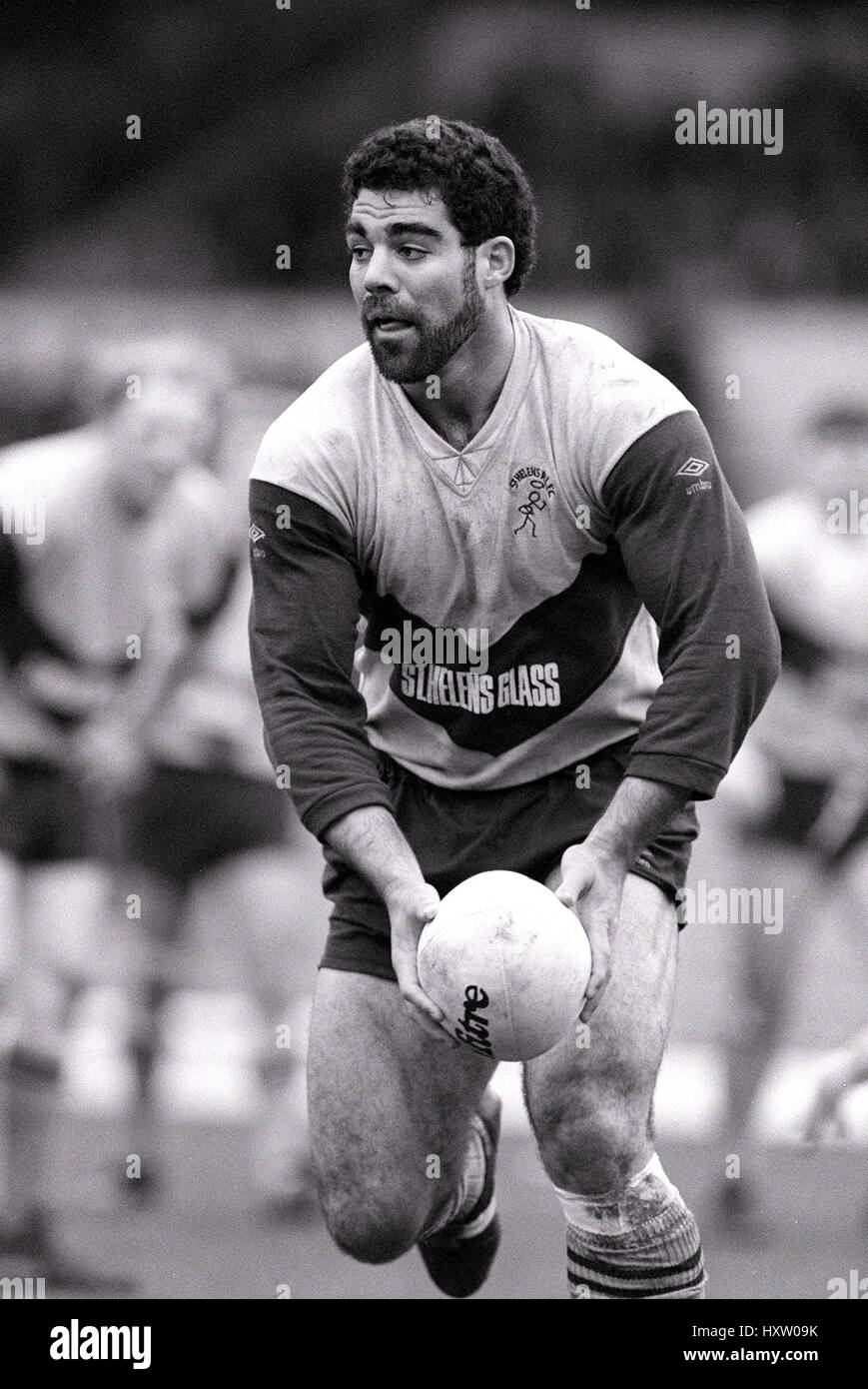
Wigan were hanging on by a thread at this point, blown away in the first half an hour by a rampant Saints side inspired by their Australian talisman. Before half-time Meninga would more or less settle matters with the Golden Try that inspires this column. A neat little run-around between Liptrot and Holding saw the ball worked out wide to Round. Rather than attempt another surge for the line the Saints second row threw a rather speculative, hooked pass of the type that in the modern game would give Wayne Bennett palpitations. Yet it turned out that Round knew exactly what he was doing, finding Meninga with enough space to beat his man again before effortlessly rounding a young fullback by the name of Shaun Edwards to touch down by the left hand corner. It all added up to a 24-2 half-time lead for Saints and although Wigan fought back in the second half with tries from Henderson Gill, Nicky Kiss and Graeme West another penalty goal from Day was enough to keep them at arms-length and secure the trophy for Billy Benyon’s side.
It was Saints first meaningful silverware since winning the Premiership Trophy in 1977. They won the Premiership again at the end of the 84/85 Meninga season but were just pipped to what would have been a first league title in 10 years by Hull KR. The Robins finished three points ahead of Saints in second and also knocked Benyon’s men out of the Challenge Cup with an 8-3 victory at Knowsley Road in February of 1985. In the league defeats at home to Wigan on Boxing Day, at Castleford at the end of January as well as at Hull FC, Oldham and at Leigh on the last day proved the undoing of the red vee. The loss to Wigan over the festive season was the only home league defeat suffered by Saints that season and when they saw Rovers off 30-14 in mid-April hopes were rekindled, only for their poor away form to ruin Saints dreams.
It would be another 11 years before Saints captured a league title, by which time they had gone 21 years without one. Meninga never returned to the club despite several suggestions and rumours that he would do so. Broken arms and no doubt a rather large wedge from the coffers of Canberra Raiders ensured that there would not be another Australian centre making that big a splash at Saints until 2005. Then, Jamie Lyon left his country life behind to rip holes in Super League defences for a couple of seasons, culminating in the treble winning year of 2006.
Meninga scored 28 tries in 31 appearances for Saints which is a record which compares reasonably to that of Ben Barba (34 in 34) and favourably with that of Lyon (46 in 63). All three will be remembered for the sprinkle of stardust they brought to Saints during their short stints, but it is perhaps Meninga who can claim to have had the biggest impact in terms of turning around the team’s form from the previous season.
You can enjoy all of the highlights described in this piece here.
But in 1984 the Lancashire Cup was still a big deal. Saints had not won it since the 1968-69 season when two Frank Wilson tries helped the red vee to a 30-2 victory over Oldham at Central Park. They made it back to the final in 1970 but lost 7-4 to Leigh at Station Road in Swinton, and they were shut-out 16-0 by Warrington in the 1982 final also at Central Park. A couple of seasons later they were back at the home of their greatest foe, and it was the cherry and whites providing the opposition this time around.
There was something different about the Saints vintage of 1984/85 and that something was Mal Meninga. The Australian test centre had starred for the Kangaroos on their 1982 tour of Great Britain, scoring 10 tries in 14 matches in a side that also included Brett Kenny, Peter Sterling, Wally Lewis and a pre-Warrington Les Boyd. Meninga had also kicked 68 goals on that tour as the Aussies won all 22 matches and earned the tag of the ‘invincibles’ way before Arsene Wenger rocked up in Islington. Included in that run was a 32-0 win over Saints at Knowsley Road. It happened to be one of the few matches on the tour in which Meninga failed to get over the try-line but they had seen enough of him that day and on the tour as a whole to know that he could significantly improve their prospects of winning silverware. It would be two more years before Meninga would arrive but he was very much worth the wait.
Those hopes of winning silverware needed a boost. The 1983/84 campaign prior to Meninga’s arrival in St.Helens had been mediocre to say the least. Saints finished 6th having lost 11 of their 30 league games. Defeats at Oldham and Leigh were particularly costly early on while there was a horrific run of six defeats in seven league games between the beginning of December and January 11. Things picked up with four wins on the spin before further losses to Leeds and Castleford halted any momentum Saints had gained. To add to their woes in the league they were knocked out of the Lancashire Cup at home to Warrington in the second round. They did reach the semi-final of the John Player Trophy but went down 18-4 to Widnes while Wigan ended Saints Challenge Cup hopes with a 16-7 round three victory at Knowsley Road in March.
Meninga did not make his Saints debut until early October 1984 by which time his new club had already suffered league defeats to Hull KR and Bradford Northern. His impact was immediate, scoring two tries in a 30-16 win over Castleford. Leigh were dispatched 31-10 in the Lancashire Cup three days later (what player welfare?) before league wins over Hunslet, Halifax and Oldham going into the October 28 Lancashire Cup Final against a Wigan side coached by Colin Clarke, father of Sky Sports irrelevant stat-man and former Wigan star Phil.
All the hard work was done in the first half. It took just five minutes for Meninga to make his first contribution to proceedings, burrowing and pirouetting between two Wigan defenders to cross for the first try of the afternoon. Sharp thinking from Graham Liptrot created the space as he switched the ball back to the short side after taking Harry Pinner’s pass from dummy half.
Meninga played a part in Saints second and third tries also. First he followed up Paul Round’s break to be on hand at dummy half when Round was hauled down just short of the line. Meninga’s quick pass from the play-the-ball found the world’s most willing runner in Roy Haggerty who went over untouched to extend Saints lead. Then after quick passing from Chris Arkwright and Neil Holding found Meninga one-on-one with opposing centre David Stephenson the man who would go on to coach Australia to a World Cup win in 2017 got on the outside of Stephenson before brilliantly finding Sean Day with a clear run to the line. Day bagged 114 goals in that 1984/85 season including five in this final. He also crossed for nine tries during that season. He wasn’t around long in a Saints shirt but Day’s star shone brightly the year that Meninga was terrorising defences on his inside.
Wigan were hanging on by a thread at this point, blown away in the first half an hour by a rampant Saints side inspired by their Australian talisman. Before half-time Meninga would more or less settle matters with the Golden Try that inspires this column. A neat little run-around between Liptrot and Holding saw the ball worked out wide to Round. Rather than attempt another surge for the line the Saints second row threw a rather speculative, hooked pass of the type that in the modern game would give Wayne Bennett palpitations. Yet it turned out that Round knew exactly what he was doing, finding Meninga with enough space to beat his man again before effortlessly rounding a young fullback by the name of Shaun Edwards to touch down by the left hand corner. It all added up to a 24-2 half-time lead for Saints and although Wigan fought back in the second half with tries from Henderson Gill, Nicky Kiss and Graeme West another penalty goal from Day was enough to keep them at arms-length and secure the trophy for Billy Benyon’s side.
It was Saints first meaningful silverware since winning the Premiership Trophy in 1977. They won the Premiership again at the end of the 84/85 Meninga season but were just pipped to what would have been a first league title in 10 years by Hull KR. The Robins finished three points ahead of Saints in second and also knocked Benyon’s men out of the Challenge Cup with an 8-3 victory at Knowsley Road in February of 1985. In the league defeats at home to Wigan on Boxing Day, at Castleford at the end of January as well as at Hull FC, Oldham and at Leigh on the last day proved the undoing of the red vee. The loss to Wigan over the festive season was the only home league defeat suffered by Saints that season and when they saw Rovers off 30-14 in mid-April hopes were rekindled, only for their poor away form to ruin Saints dreams.
It would be another 11 years before Saints captured a league title, by which time they had gone 21 years without one. Meninga never returned to the club despite several suggestions and rumours that he would do so. Broken arms and no doubt a rather large wedge from the coffers of Canberra Raiders ensured that there would not be another Australian centre making that big a splash at Saints until 2005. Then, Jamie Lyon left his country life behind to rip holes in Super League defences for a couple of seasons, culminating in the treble winning year of 2006.
Meninga scored 28 tries in 31 appearances for Saints which is a record which compares reasonably to that of Ben Barba (34 in 34) and favourably with that of Lyon (46 in 63). All three will be remembered for the sprinkle of stardust they brought to Saints during their short stints, but it is perhaps Meninga who can claim to have had the biggest impact in terms of turning around the team’s form from the previous season.
You can enjoy all of the highlights described in this piece here.
Golden Moments – Matty Smith v Salford Red Devils – 2017
You’re probably still feeling too physically sick at Saints Super League semi-final defeat to Warrington to have noticed much of the other RL-related news of the week. If so, you might not have noticed that Matty Smith’s move to Catalans Dragons was confirmed in the last few days. It brought to an end a third spell at his hometown club for Smith and led to whopping great billows of steam emanating from the ears of Dragons halfback Josh Drinkwater. The Australian has been credited with almost single-handedly transforming the French side’s season, from bottom four certainties during the cold snap of the early months of the year to Challenge Cup winners by the end of August. Yet despite Smith’s lack of involvement in Saints run to the League Leaders Shield in 2018 Dragons coach Steve McNamara thinks he is the man to lead his side around the field in 2019 as they look to improve on their eighth place finish.
Smith’s third spell at Saints has not been glorious. It started badly with a broken leg in a pre-season friendly with Widnes which kept him out of the side until late March when he started in a 31-6 home defeat of Warrington. That came after he had been signed by Keiron Cunningham amid all kinds of overly optimistic references to the Promised Land. The hard sell was that Smith had come home after a trophy-winning spell with Wigan to finally shine in the red vee number 7 jersey that had first been taken from him by Sean Long and then Kyle Eastmond in his previous spells. Finally he would fulfil his destiny.
It didn’t quite work out like that. By the start of 2018 Justin Holbrook, having replaced Cunningham as head coach, had seen enough to convince him that Danny Richardson should be the starting scrum half and that if a back was required on the bench then it would be Theo Fages getting the nod ahead of Smith more often than not. Smith last featured in a Saints match day 17 in early June during a 26-4 win over Hull KR. Amid suggestions that he was less than keen to play at Sheffield Eagles on dual registration the former England half was phased out by Holbrook and will now look to forge a happy ending to his storied career in the south of France.
Almost a year before that last appearance for Saints Smith enjoyed the standout moment of his final spell in Saints colours. Saints faced a visit from Salford Red Devils, five games out from the end of a regular season that had become something of a scrap to stay in contention for the playoffs. Saints remain the only side to have qualified for every playoff series since the inception of the Grand Final in 1998 but were in real danger of losing that proud record when Ian Watson brought his much improved Salford side to town. After years of mediocrity the Red Devils where finally challenging the top four at that point. This might well be remembered as the game which broke their resolve. They went on to lose four of their last five regular season games before falling in complete heap in the Super 8s, winning only one of seven to finally finish the season in a disappointing seventh place.
Saints meanwhile were the very definition of up and down ahead of this clash. The latter stages of the Cunningham reign had seen some toxic atmospheres at home games. The statued hero of the Saints faithful was reduced to the subject of boos every time his face appeared on screen during televised defeats at home to Wakefield and away at Salford. By the time Huddersfield clawed their way back from 14-0 down at half-time to draw 14-14 at Saints in early April Cunningham’s position became untenable. A trio of Under-19s coach Derek Traynor, former great Long and assistant Jamahl Lolesi took over on a temporary basis until Holbrook was appointed in May. During that time the mood lightened even if results didn’t immediately improve. A 29-18 loss at Wigan on Good Friday was thought mostly due to the harsh dismissal of Kyle Amor for a chest high tackle and there were fairly abject defeats at Widnes and Warrington before a very public 53-10 shellacking in the Challenge Cup represented something of a nadir.
A week after that BBC TV humbling at the Mend-A-Hose Jungle Saints, who had surprised runaway league leaders Castleford 26-22 on Easter Monday travelled to Newcastle to face Hull FC at the Magic Weekend. Holbrook was in the country and in the dressing room, along with former Brisbane, Cronulla and Canterbury fullback Ben Barba who was rumoured to be considering joining Saints after being banned from the NRL for 12 games following a positive drugs test at the end of the 2016 Grand Final. The boost given to the team by the arrival of the coach and the suggestion of a genuine superstar climbing on board had quite some effect on the Saints players, who blasted FC off the park to the tune of 45-0. They followed that with a narrow home win over Wigan and although a highly dubious offside decision denied them victory at Castleford they got back on the horse with a comfortable 26-10 home win over Widnes. They then went to Huddersfield and lost 24-16, so by the time the Red Devils rocked up on June 23 their playoff hopes remained in the balance.
In a tight first half Smith had gone over for Saints first try of the evening, converted by Mark Percival to give his side a 6-2 lead after Todd Carney had notched an early penalty. Niall Evalds pounced on a Zeb Taia error to score the first of his two tries to put Salford back in the lead but the teams went to the sheds level at 8-8 when Percival converted a penalty. Second half tries from Evalds, Robert Lui and Greg Johnson looked to have won the game for Salford, leaving Saints hopes of qualifying for the semi-finals hanging by the merest, anorexic thread. But those who thought that had reckoned without a Saintsy spell in which Saints scored three tries in the final seven minutes of the game as James Roby, Regan Grace and Jonny Lomax all went over in a frantic finale. If that evoked memories of Wide To West and the celebrated comeback at Warrington of 2005, what happened next went straight into the Smith family scrapbook.
Quite clearly peeved with the idea of having to settle for a draw in a game that they had been in control of five minutes earlier, Salford self-destructed. Taking possession of the ball just inside his own half with barely seconds remaining, Lui’s brain went for a walk taking the rest of his body reluctantly kicking and screaming with it. His chip over the top of the Saints defence cannot be accurately described by the term ill-advised but I’m afraid that is the nearest phrase at this writer’s disposal to sum it up. Never threatening to find a Salford team-mate, the chip fell kindly into the arms of a grateful Louie McCarthy-Scarsbrook, his top-knotted barnet flowing in the summer breeze as he turned to find Smith in space. Saints thrice forgotten man scooped up the ball and in one movement, a step outside the 40 metre line, planted a quite delicious drop goal straight between the uprights to turn a once certain defeat into a barely explicable win. In celebration he set sail towards the West end of the ground where the majority of the home support congregate behind the posts and triumphantly led the wild celebrations. It never got any better in a Saints shirt for Smith, but it was a memory that literally thousands of kids growing up playing rugby league on the streets of the town would kill for.
It was a real turning point for Saints if not for Smith. He was lost to an eye injury the following week in a 24-22 loss at Leeds but Saints finished the regular season with wins over Hull FC, Catalans Dragons and a first away success of the campaign at Wakefield to climb into the top four. They held the boat steady during the Super 8s despite defeats to Wigan, Leeds and Hull FC, beating Wakefield, Huddersfield and wouldn’t you just know it Salford in their final three to secure a playoff place and keep their tag of playoff ever-presents. Whereupon another famous drop goal proved their undoing in the semi-final against Castleford.
As Smith prepares to embark on what might well be the last journey of his career we prefer to remember his one-pointer rather than that of Luke Gale three months later.
Smith’s third spell at Saints has not been glorious. It started badly with a broken leg in a pre-season friendly with Widnes which kept him out of the side until late March when he started in a 31-6 home defeat of Warrington. That came after he had been signed by Keiron Cunningham amid all kinds of overly optimistic references to the Promised Land. The hard sell was that Smith had come home after a trophy-winning spell with Wigan to finally shine in the red vee number 7 jersey that had first been taken from him by Sean Long and then Kyle Eastmond in his previous spells. Finally he would fulfil his destiny.
It didn’t quite work out like that. By the start of 2018 Justin Holbrook, having replaced Cunningham as head coach, had seen enough to convince him that Danny Richardson should be the starting scrum half and that if a back was required on the bench then it would be Theo Fages getting the nod ahead of Smith more often than not. Smith last featured in a Saints match day 17 in early June during a 26-4 win over Hull KR. Amid suggestions that he was less than keen to play at Sheffield Eagles on dual registration the former England half was phased out by Holbrook and will now look to forge a happy ending to his storied career in the south of France.
Almost a year before that last appearance for Saints Smith enjoyed the standout moment of his final spell in Saints colours. Saints faced a visit from Salford Red Devils, five games out from the end of a regular season that had become something of a scrap to stay in contention for the playoffs. Saints remain the only side to have qualified for every playoff series since the inception of the Grand Final in 1998 but were in real danger of losing that proud record when Ian Watson brought his much improved Salford side to town. After years of mediocrity the Red Devils where finally challenging the top four at that point. This might well be remembered as the game which broke their resolve. They went on to lose four of their last five regular season games before falling in complete heap in the Super 8s, winning only one of seven to finally finish the season in a disappointing seventh place.
Saints meanwhile were the very definition of up and down ahead of this clash. The latter stages of the Cunningham reign had seen some toxic atmospheres at home games. The statued hero of the Saints faithful was reduced to the subject of boos every time his face appeared on screen during televised defeats at home to Wakefield and away at Salford. By the time Huddersfield clawed their way back from 14-0 down at half-time to draw 14-14 at Saints in early April Cunningham’s position became untenable. A trio of Under-19s coach Derek Traynor, former great Long and assistant Jamahl Lolesi took over on a temporary basis until Holbrook was appointed in May. During that time the mood lightened even if results didn’t immediately improve. A 29-18 loss at Wigan on Good Friday was thought mostly due to the harsh dismissal of Kyle Amor for a chest high tackle and there were fairly abject defeats at Widnes and Warrington before a very public 53-10 shellacking in the Challenge Cup represented something of a nadir.
A week after that BBC TV humbling at the Mend-A-Hose Jungle Saints, who had surprised runaway league leaders Castleford 26-22 on Easter Monday travelled to Newcastle to face Hull FC at the Magic Weekend. Holbrook was in the country and in the dressing room, along with former Brisbane, Cronulla and Canterbury fullback Ben Barba who was rumoured to be considering joining Saints after being banned from the NRL for 12 games following a positive drugs test at the end of the 2016 Grand Final. The boost given to the team by the arrival of the coach and the suggestion of a genuine superstar climbing on board had quite some effect on the Saints players, who blasted FC off the park to the tune of 45-0. They followed that with a narrow home win over Wigan and although a highly dubious offside decision denied them victory at Castleford they got back on the horse with a comfortable 26-10 home win over Widnes. They then went to Huddersfield and lost 24-16, so by the time the Red Devils rocked up on June 23 their playoff hopes remained in the balance.
In a tight first half Smith had gone over for Saints first try of the evening, converted by Mark Percival to give his side a 6-2 lead after Todd Carney had notched an early penalty. Niall Evalds pounced on a Zeb Taia error to score the first of his two tries to put Salford back in the lead but the teams went to the sheds level at 8-8 when Percival converted a penalty. Second half tries from Evalds, Robert Lui and Greg Johnson looked to have won the game for Salford, leaving Saints hopes of qualifying for the semi-finals hanging by the merest, anorexic thread. But those who thought that had reckoned without a Saintsy spell in which Saints scored three tries in the final seven minutes of the game as James Roby, Regan Grace and Jonny Lomax all went over in a frantic finale. If that evoked memories of Wide To West and the celebrated comeback at Warrington of 2005, what happened next went straight into the Smith family scrapbook.
Quite clearly peeved with the idea of having to settle for a draw in a game that they had been in control of five minutes earlier, Salford self-destructed. Taking possession of the ball just inside his own half with barely seconds remaining, Lui’s brain went for a walk taking the rest of his body reluctantly kicking and screaming with it. His chip over the top of the Saints defence cannot be accurately described by the term ill-advised but I’m afraid that is the nearest phrase at this writer’s disposal to sum it up. Never threatening to find a Salford team-mate, the chip fell kindly into the arms of a grateful Louie McCarthy-Scarsbrook, his top-knotted barnet flowing in the summer breeze as he turned to find Smith in space. Saints thrice forgotten man scooped up the ball and in one movement, a step outside the 40 metre line, planted a quite delicious drop goal straight between the uprights to turn a once certain defeat into a barely explicable win. In celebration he set sail towards the West end of the ground where the majority of the home support congregate behind the posts and triumphantly led the wild celebrations. It never got any better in a Saints shirt for Smith, but it was a memory that literally thousands of kids growing up playing rugby league on the streets of the town would kill for.
It was a real turning point for Saints if not for Smith. He was lost to an eye injury the following week in a 24-22 loss at Leeds but Saints finished the regular season with wins over Hull FC, Catalans Dragons and a first away success of the campaign at Wakefield to climb into the top four. They held the boat steady during the Super 8s despite defeats to Wigan, Leeds and Hull FC, beating Wakefield, Huddersfield and wouldn’t you just know it Salford in their final three to secure a playoff place and keep their tag of playoff ever-presents. Whereupon another famous drop goal proved their undoing in the semi-final against Castleford.
As Smith prepares to embark on what might well be the last journey of his career we prefer to remember his one-pointer rather than that of Luke Gale three months later.
Steve Prescott Man Of Steel - Why It Had To Be Barba
That Saints Blog You Quite Like was going to take a break after the trauma of the semi-final defeat to Warrington. The Grand Final may be happening at the weekend but it is entirely dead to this writer, for whom picking a winner is like choosing which of the Hairy Bikers’ belly buttons you want to lick honey off. However, social media never lets me down when it comes to content ideas and so here we are back again, with another stream of consciousness rant cunningly disguised as a considered column.
Last night saw Ben Barba pick up the Steve Prescott Man Of Steel award. Contrary to its title, this award is not given to the player showing the kind of toughness or courage that was the hallmark of Prescott. Nobody could show that kind of courage on a rugby league field. Prescott was different gravy as a man and as an inspiration to everyone in the game and everyone who watched it. But the award that bears his name is given to the best player of any particular season. The most skilful, the most effective, the one who puts the bums on the seats. Barba was nominated alongside Saints team-mate James Roby and Wigan snarler and some time England centre John Bateman. Bafflingly, there is still some debate among the Twitterati about whether or not the Australian fullback should have taken the award.
It’s not that Roby or Bateman haven’t been good enough. They have been very, very good. Having watched Roby first hand week in week out I can assure you that he hasn’t had a bad game since he lost at table tennis in the games room of the England hotel during the last World Cup. He’s all action, tackles everything, makes breaks, leads, is inexhaustible and makes any side that he is in 20% better. I don’t see as much of Bateman as I do Roby and Barba but I am sure that he too has those same qualities. His stats will bear that out, seventh in metres made, second in carries, top of the pile in offloads. And that is throughout the whole league. His form has been good enough to convince Canberra Raiders to offer him a three-year deal in the NRL from 2019. And I expect him to be much more of a success than some of the other Wigan ‘stars’ that have tried their hand in Australia before heading home, tail firmly between legs.
Yet these two, for all their endeavour and excellence, cannot match what Barba has brought to Saints and to Super League in 2018. His detractors claim that he has only played half a season, and that defensively he isn’t very good. The first is the kind of schoolboy myth up there with the idea that the bigger boys shove your head down the toilet on your first day of secondary school, and the second just isn’t bloody relevant. You don’t buy a lawn mower to sweep the kitchen floor. When Barba arrived at Saints nobody was expecting him to save tries and be the defensive rock that Paul Wellens once was in the red vee. They were expecting him to go on those dizzying runs that we had all seen on the NRL highlight films, to score lots of tries and generally terrorise defences. Which he has done. He has scored 28 tries in his 29 appearances for Saints this year and added 24 assists. He has busted out of 141 tackles, a tally only Mark Percival can better, and has made 30 clean breaks. Along with coach Justin Holbrook Barba has revolutionised the way that Saints have approached the game after a stale few years.
Yet for all the stats it is the sheer joy that he has brought to fans inside the stadium that mark him out as a clear winner of the Steve Prescott Man Of Steel. He has made going to the game fun again at a time when we had become weary of the kind of five drives drivel served up by leading Super League sides over what is now getting on for a decade. His form hit a rough patch which coincided with the whole team falling into a sorry state just after the shock defeat to Catalans in the Challenge Cup semi-final. Saints form never really recovered from that jolt, and while Barba busied himself negotiating his exit and counting his money in front of the Hull FC fans there was a four or five game spell when it looked as though he had had enough and was just playing out time. Yet once the contract with North Queensland Cowboys was sorted he shot back into gear, destroying Warrington at the Halliwel Jones at the end of September and adding another double in a 26-0 shutout of Castleford a week later. The semi-final loss to Warrington was due more to some bewilderingly conservative tactics than it was to any loss of form on Barba’s part. Sure, you can throw a brickbat at him that he showed a less than exemplary attitude during his contract negotiations, but the length of time for which he was ordinary has been exaggerated greatly. And remember he was never that bad. Just ordinary. Human for a month.
The bottom line is that most right thinking rugby league fans don’t pay their hard earned money to watch uber-consistent grafters like Bateman, or even Roby now that the dynamism of his youth is on the wane. They pay to watch the players that can do something different, that can win a game on their own with one or two pieces of pure inspiration and magic. Barba did this consistently throughout the year, for a much longer period than the naysayers would have you believe as they darkly mutter that they knew he was a load of rubbish weeks before our season began to unravel at Bolton in early August. The absence of the big prizes might slightly taint the legacy of Barba if we are comparing him with great Saints imports of the past like Mal Meninga or Jamie Lyon. But it would have been an absolute travesty not to crown him the league’s best player for 2018 because one day we will all look back and remember fondly the year that we had Ben Barba in Super League.
We may not see a player like him in our competition for some time to come.
Last night saw Ben Barba pick up the Steve Prescott Man Of Steel award. Contrary to its title, this award is not given to the player showing the kind of toughness or courage that was the hallmark of Prescott. Nobody could show that kind of courage on a rugby league field. Prescott was different gravy as a man and as an inspiration to everyone in the game and everyone who watched it. But the award that bears his name is given to the best player of any particular season. The most skilful, the most effective, the one who puts the bums on the seats. Barba was nominated alongside Saints team-mate James Roby and Wigan snarler and some time England centre John Bateman. Bafflingly, there is still some debate among the Twitterati about whether or not the Australian fullback should have taken the award.
It’s not that Roby or Bateman haven’t been good enough. They have been very, very good. Having watched Roby first hand week in week out I can assure you that he hasn’t had a bad game since he lost at table tennis in the games room of the England hotel during the last World Cup. He’s all action, tackles everything, makes breaks, leads, is inexhaustible and makes any side that he is in 20% better. I don’t see as much of Bateman as I do Roby and Barba but I am sure that he too has those same qualities. His stats will bear that out, seventh in metres made, second in carries, top of the pile in offloads. And that is throughout the whole league. His form has been good enough to convince Canberra Raiders to offer him a three-year deal in the NRL from 2019. And I expect him to be much more of a success than some of the other Wigan ‘stars’ that have tried their hand in Australia before heading home, tail firmly between legs.
Yet these two, for all their endeavour and excellence, cannot match what Barba has brought to Saints and to Super League in 2018. His detractors claim that he has only played half a season, and that defensively he isn’t very good. The first is the kind of schoolboy myth up there with the idea that the bigger boys shove your head down the toilet on your first day of secondary school, and the second just isn’t bloody relevant. You don’t buy a lawn mower to sweep the kitchen floor. When Barba arrived at Saints nobody was expecting him to save tries and be the defensive rock that Paul Wellens once was in the red vee. They were expecting him to go on those dizzying runs that we had all seen on the NRL highlight films, to score lots of tries and generally terrorise defences. Which he has done. He has scored 28 tries in his 29 appearances for Saints this year and added 24 assists. He has busted out of 141 tackles, a tally only Mark Percival can better, and has made 30 clean breaks. Along with coach Justin Holbrook Barba has revolutionised the way that Saints have approached the game after a stale few years.
Yet for all the stats it is the sheer joy that he has brought to fans inside the stadium that mark him out as a clear winner of the Steve Prescott Man Of Steel. He has made going to the game fun again at a time when we had become weary of the kind of five drives drivel served up by leading Super League sides over what is now getting on for a decade. His form hit a rough patch which coincided with the whole team falling into a sorry state just after the shock defeat to Catalans in the Challenge Cup semi-final. Saints form never really recovered from that jolt, and while Barba busied himself negotiating his exit and counting his money in front of the Hull FC fans there was a four or five game spell when it looked as though he had had enough and was just playing out time. Yet once the contract with North Queensland Cowboys was sorted he shot back into gear, destroying Warrington at the Halliwel Jones at the end of September and adding another double in a 26-0 shutout of Castleford a week later. The semi-final loss to Warrington was due more to some bewilderingly conservative tactics than it was to any loss of form on Barba’s part. Sure, you can throw a brickbat at him that he showed a less than exemplary attitude during his contract negotiations, but the length of time for which he was ordinary has been exaggerated greatly. And remember he was never that bad. Just ordinary. Human for a month.
The bottom line is that most right thinking rugby league fans don’t pay their hard earned money to watch uber-consistent grafters like Bateman, or even Roby now that the dynamism of his youth is on the wane. They pay to watch the players that can do something different, that can win a game on their own with one or two pieces of pure inspiration and magic. Barba did this consistently throughout the year, for a much longer period than the naysayers would have you believe as they darkly mutter that they knew he was a load of rubbish weeks before our season began to unravel at Bolton in early August. The absence of the big prizes might slightly taint the legacy of Barba if we are comparing him with great Saints imports of the past like Mal Meninga or Jamie Lyon. But it would have been an absolute travesty not to crown him the league’s best player for 2018 because one day we will all look back and remember fondly the year that we had Ben Barba in Super League.
We may not see a player like him in our competition for some time to come.
5 Talking Points From Saints 13 Warrington Wolves 18
Crash
The aftermath of this 18-13 defeat to Warrington is filled with all the usual post-defeat emotions. Frustration, sadness, a tinge of anger and a dash of bewilderment.
We'd considered the possibility of not making the Grand Final in 2018 but only fleetingly. We'd been dominant. Just four losses in 30 league games taking in the 23-game regular season and the soon-to-be-forgotten Super 8s. We had the competition's best player, its best and most consistent hooker. We had two young, exciting halves and a pack featuring a nice mix of savvy veterans and explosive youngsters. Nobody really came close to Saints throughout most of the 2018 season. And yet the nature of the competition meant that one slip was all it would take to see it all come crashing down. That slip had seemed increasingly likely as the year wore on. The fearful pasting we took at Bolton in the Challenge Cup semi-final defeat to Catalans Dragons was our alarm call. The blaring noises got louder throughout Super 8s defeats to Huddersfield and Wigan at home. Suddenly we were vulnerable. Just another side, one of four with an even shot at winning the title. Well, no longer.
It's indisputable that Saints have been the best side over the 2018 season but it is of little consolation. We all knew the rules at the start of the season, rules that have been in place in Super League for 20 years taking into account a little tweak here and there. Whatever the playoff format the Grand Final has been the be all and end all of Super League since Wigan won the first one against Leeds Rhinos in 1998. We've suffered from it and we have profited from it throughout the first two decades of summer rugby. That's just how it is. We all accept it whether we agree with the concept or not, so now is not the time for bleating about the injustices of the system. Now is a time for deep reflection and, if social media is anything to go by, no small amount of knee-jerking. Frustrated fans look for scapegoats and some take it so badly that their memories erase everything that happened before the semi-final until the season is boiled down to a complete and overwhelming disaster. Playoff systems are an unforgiving beast.
Yet even if you can rationalise things a little better than that there is no getting away from the meaning behind the defeat. It means that someone other than Saints will be crowned Super League champions and it means that for a fourth successive season Saints have failed to win one of the two major trophies on offer in the professional domestic game. It also marks the fourth season in a row since their last Grand Final win in 2014 that Saints have fallen at the semi-final stage. Of all of those this one probably stings the most. This was the one with the most expectation attached to it. The first two in 2015 and 2016 were achieved with Keiron Cunningham's Grind rugby that few fans wanted or believed in. The third was lost to a Castleford side which had swept everything before it in the regular season and Super 8s before suffering its own moment of stark realisation of the full horror of playoff football in the Grand Final against Leeds. And even then it was a semi-final in which Saints went down by just a single point in almost heroic circumstances. The scapegoat hunters blamed Ryan Morgan for his late obstruction on Michael Shenton but they were drowned out by the sensible majority who recognised that this was a team that had given everything against another that had been superior to everyone all year. This year feels different. This year it feels like we could and should have done so much more to win this game and reach Old Trafford.
You have to credit Warrington and their coach Steve Price. Having seen his team torn apart on their own patch by Saints just 12 days before this encounter he went away and figured out a gameplan to stop that happening again. He has dragged a team which finished in the bottom four in 2017 to the top four in 2018 and now into their second major final of the season. That's quite some turnaround whether they end the season as champions or end it empty handed.
And so we are left with just a sense of disappointment, of shock and of quite a bit of regret. Lessons need to be learned if a Saints side that will look quite different in 2019 is to challenge again for the major prizes. The nucleus of a great side is in place and they are where they are due to some pretty fine margins. But hey that is sport. Time to suck it up, come back stronger next year. But not before we've taken a little look at what went wrong on the night. This might smart a bit if you are of a red vee persuasion.
Did Holbrook Pick The Right Team?
Having rested key players for the Super 8s games which led into this one Justin Holbrook had the benefit of having almost everyone fully fit. Only Alex Walmsley and Adam Swift remained unavailable as Jonny Lomax, Luke Thompson, Mark Percival and Jon Wilkin returned after taking a breather for the win over Castleford.
That reliance of experience over youth was expected. Three of those four have just been selected for Wayne Bennett's England squad which will take on New Zealand in a three-test series in the autumn. The surprise came at hooker where Morgan Knowles started with James Roby on the bench and no place in the 17 for Theo Fages. Roby is due to have surgery in the off season and so misses the test series with England. If there is a doubt about his fitness then perhaps Holbrook had no choice but to hold Roby back a little. In the event he played almost an hour of the game and was, as ever, one of Saints better performers. Forty-two tackles, 107 metres on 11 carries with three tackle busts show that the skipper offered his usual all action presence.
There is a bigger question surrounding the omission of Fages. The Frenchman was left out of the 17 for the recent home defeat by Wigan, a decision which cost Holbrook as Morgan left the fray early to allow Sean O'Loughlin and Joe Greenwood to ruthlessly expose Saints' makeshift left edge. Injuries cannot be predicted but the omission of Fages seemed to leave Saints vulnerable. He had been one of the keys to that 34-14 win at Warrington less than a fortnight ago, coming off the bench to contribute a try assist, 35 tackles, a clean break and an offload.
There's no suggestion that Fages is an undroppable, world class talent that no side can do without. This is a Saints side that has won games in 2018 without Ben Barba who maybe is in that bracket. But what Fages does give you is flexibility and options. Lomax finished the game with a compound fracture in his finger, almost certainly rendering him unable to take Barba's pass after the fullback had made a trademark thrust through the Warrington line late in the second half. Would Lomax have been left on the field had Fages been available? It's all hindsight but even without Lomax's injury Fages' considerable skills could surely have been put to good use. Fages is a risk taker and to his cost Holbrook had clearly decided beforehand that he wanted to be more conservative this time around.
The longer term worry is that Saints may lose Fages sooner rather than later. Missing the very biggest games is becoming a theme for him under Holbrook and few would blame him if he looked elsewhere for more game time. Our loss could be someone else's gain if Fages goes on to fulfil his potential elsewhere. For all the plaudits that Holbrook has rightfully taken for improving the limited squad of players left by Keiron Cunningham perhaps Fages is the one most in danger of going backwards under the Australian coach.
Did Holbrook Get The Gameplan Right?
The absence of Fages may not have been so screamingly obvious had Saints played with anything like the confidence and ambition that they had in that win over Warrington. A frantic contest was littered with offloads and second phases of play, all of which flew hastily out of the window this time. Thompson and Luke Douglas ran with heart and no shortage of effort but only the latter showed any inclination to turn in a tackle and keep the ball alive. And even then without success as he managed to draw a complete blank in the offload category. Saints managed just five offloads between them here, which is just one more than Jack Ashworth managed by himself during that previous meeting.
That Douglas grabbed Saints only try, a scruffy affair from a Danny Richardson kick that both Stefan Ratchford and Kevin Brown had ample opportunity to deal with, spoke volumes for their tactical approach. It was almost back to Cunningham-era tactics, playing out the sets and hoping to build pressure with a kick on the last. It felt like Holbrook had abandoned his own attacking principles and decided instead that only a safety first approach could prosper in playoff football. When you add into the mix some spectacularly poor last tackle options its a recipe for the proverbial. Richardson looks ever more bewildered when the onus is on him to conjure up something on the last play, while Barba, Roby and Percival were all guilty of poking weak nothing kicks into the arms of Wolves defenders or over the sideline close to the try line on play six. There was one head scratching example of Saints' last play cluelessnes which summed up all the rest when Tommy Makinson found himself aimlessly punting the ball down the field from the right touchline. And this was during the first half, a time before panic had not even had a chance to take off its coat and grab a complimentary glass of bucks fizz much less settle in for the night.
Richardson was powerless to control the game. There was too little variety in his kicking game. Plan A was the aimless bomb invariably gobbled up by Ratchford and Plan B was the crossfield bomb to Makinson which Wire's defence dealt with comfortably. When he wasn't kicking on the last Richardson was dithering, caught in possession for the turnover after failing to convince the defence that he could offer a real running threat. Repeated comparisons to Sean Long threaten to strangle Richardson's career before it has even began. Literally the only sensible comparison to be made between the two is the colour of their hair. Richardson has potential at this level but please can we leave him to develop it without lazy, inaccurate comparisons?
Of course it would have helped Richardson if he was not so heavily relied on. A more expansive gameplan could have led to far less need for him to produce the kind of last tackle magic that he does not yet possess. In that framework he can contribute well and even shine but as a key playmaker he has a distance to travel. We said when he ousted Matty Smith from the starting halfback role that there may be some pain before the gain with a youngster like Richardson and this is part of that process. Persevere with Richardson absolutely, but don't build him up to be someone he is not and even more importantly, don't build a gameplan for a semi-final that requires him to be what he is not. Yet.
Experience Could Still Have Saved Us
For all the flaws in Saints game there were some very basic things that experienced players could have done which might have seen us through. Much has been said about the decision to go for goal from a second half penalty by the north stand touchline. Richardson missed the opportunity but it was the only goal he missed on a night when he kicked three drop-goals. On another night those drop goals could have made him the hero.
The decision to go for goal was probably influenced by how badly Saints had been struggling in attack. It's very un-Saintsy but there seemed no belief in getting over for a try at that point. From what had gone before it was hard to disagree with that. With one or two points in it for large parts of the game taking any points on offer seemed reasonable, particularly with Richardson in the ranks.
It didn't work out, but it might not have mattered had Saints defended their try line better in the second half. An almost impregnable rear-guard in the first half crumbled after the break. Just minutes after Douglas' try had given Saints a 9-2 lead Percival stumbled dizzily out of Jack Hughes' way as he crossed to get Wire back in the game. Then came Tom Lineham's double. Barba laid down hopefully for the first, a challenge that told you that whatever happened on this night Barba would not be picking up an injury that might jeopardise his new deal with North Queensland. For the second Barba was again involved, statuesque as Lineham rounded him with ease having stepped out of Richardson's hopeful grab. For all he has dazzled us with his genius attacking play in 2018 Barba has defended for the most part like Clare Grogan trying to squash large pieces of fruit with a juicer on that classic episode of Shooting Stars. It makes you yearn for Adam Quinlan.
The New Saints
As Barba lay blubbering on the Totally Wicked turf thoughts turned to next year. The star attraction won't be around in 2019, while Jon Wilkin and Matty Smith also depart. Lachlan Coote replaces Barba although he is a very different player style wise. The polite euphemism is that he is steadier. Less of the spectacular but perhaps a little more reliable as a last line of defence. You could offer the same description of a Black and Decker drill.
The arrival of Joseph Paulo to replace Wilkin seems as straightforward a swap as you can expect when an NRL player is involved. Don't expect Paulo to give you the longevity and loyalty of Wilkin but do expect him to get through a similar amount of work while being good enough with the ball to provide a useful link between the backs and the forwards. Just don't play him at halfback please, Justin. Paulo is a back rower who may force Knowles to continue to share playing time as he has with Wilkin but who looks well capable of offering something to the Saints philosophy. A philosophy embodied by Wilkin whose emotional post-game speech said everything about him as a man, a player and a Saint after more than 400 appearances across 16 glorious years. Jon, we thank you.
Also arriving for next year is Kevin Naiqama, which is a little more complicated. There's no suggestion yet that Morgan will leave but there are only two centre spots between Naiqama, Morgan and Percival. Naiqama can play wing or fullback too but there is competition at the back from Coote and Lomax and out wide with Swift, Makinson and Regan Grace. If Morgan doesn't leave then someone is going to be this year's Matty Smith. A Super League player who would start for many clubs but who will find himself the odd one out. Which in many ways brings us back to Fages and his future in the red vee.
There's a lot for Holbrook to sort out and with a League Leaders Shield under his belt and 26 wins from 30 games included in that we should certainly put our trust in him to figure out the solutions. A recent WA12 Rugby League Show poll has Holbrook leading the way as the man you would select to coach a Saints Super League Dream Team. Ahead of legends of the club and the game like Ian Millward, Daniel Anderson and Shaun McRae. He did not justify that faith in this crushing loss that ends our 2018 adventure but all the pieces are in place for him to fulfil the promise of his first full season.
It's up to him now.
The aftermath of this 18-13 defeat to Warrington is filled with all the usual post-defeat emotions. Frustration, sadness, a tinge of anger and a dash of bewilderment.
We'd considered the possibility of not making the Grand Final in 2018 but only fleetingly. We'd been dominant. Just four losses in 30 league games taking in the 23-game regular season and the soon-to-be-forgotten Super 8s. We had the competition's best player, its best and most consistent hooker. We had two young, exciting halves and a pack featuring a nice mix of savvy veterans and explosive youngsters. Nobody really came close to Saints throughout most of the 2018 season. And yet the nature of the competition meant that one slip was all it would take to see it all come crashing down. That slip had seemed increasingly likely as the year wore on. The fearful pasting we took at Bolton in the Challenge Cup semi-final defeat to Catalans Dragons was our alarm call. The blaring noises got louder throughout Super 8s defeats to Huddersfield and Wigan at home. Suddenly we were vulnerable. Just another side, one of four with an even shot at winning the title. Well, no longer.
It's indisputable that Saints have been the best side over the 2018 season but it is of little consolation. We all knew the rules at the start of the season, rules that have been in place in Super League for 20 years taking into account a little tweak here and there. Whatever the playoff format the Grand Final has been the be all and end all of Super League since Wigan won the first one against Leeds Rhinos in 1998. We've suffered from it and we have profited from it throughout the first two decades of summer rugby. That's just how it is. We all accept it whether we agree with the concept or not, so now is not the time for bleating about the injustices of the system. Now is a time for deep reflection and, if social media is anything to go by, no small amount of knee-jerking. Frustrated fans look for scapegoats and some take it so badly that their memories erase everything that happened before the semi-final until the season is boiled down to a complete and overwhelming disaster. Playoff systems are an unforgiving beast.
Yet even if you can rationalise things a little better than that there is no getting away from the meaning behind the defeat. It means that someone other than Saints will be crowned Super League champions and it means that for a fourth successive season Saints have failed to win one of the two major trophies on offer in the professional domestic game. It also marks the fourth season in a row since their last Grand Final win in 2014 that Saints have fallen at the semi-final stage. Of all of those this one probably stings the most. This was the one with the most expectation attached to it. The first two in 2015 and 2016 were achieved with Keiron Cunningham's Grind rugby that few fans wanted or believed in. The third was lost to a Castleford side which had swept everything before it in the regular season and Super 8s before suffering its own moment of stark realisation of the full horror of playoff football in the Grand Final against Leeds. And even then it was a semi-final in which Saints went down by just a single point in almost heroic circumstances. The scapegoat hunters blamed Ryan Morgan for his late obstruction on Michael Shenton but they were drowned out by the sensible majority who recognised that this was a team that had given everything against another that had been superior to everyone all year. This year feels different. This year it feels like we could and should have done so much more to win this game and reach Old Trafford.
You have to credit Warrington and their coach Steve Price. Having seen his team torn apart on their own patch by Saints just 12 days before this encounter he went away and figured out a gameplan to stop that happening again. He has dragged a team which finished in the bottom four in 2017 to the top four in 2018 and now into their second major final of the season. That's quite some turnaround whether they end the season as champions or end it empty handed.
And so we are left with just a sense of disappointment, of shock and of quite a bit of regret. Lessons need to be learned if a Saints side that will look quite different in 2019 is to challenge again for the major prizes. The nucleus of a great side is in place and they are where they are due to some pretty fine margins. But hey that is sport. Time to suck it up, come back stronger next year. But not before we've taken a little look at what went wrong on the night. This might smart a bit if you are of a red vee persuasion.
Did Holbrook Pick The Right Team?
Having rested key players for the Super 8s games which led into this one Justin Holbrook had the benefit of having almost everyone fully fit. Only Alex Walmsley and Adam Swift remained unavailable as Jonny Lomax, Luke Thompson, Mark Percival and Jon Wilkin returned after taking a breather for the win over Castleford.
That reliance of experience over youth was expected. Three of those four have just been selected for Wayne Bennett's England squad which will take on New Zealand in a three-test series in the autumn. The surprise came at hooker where Morgan Knowles started with James Roby on the bench and no place in the 17 for Theo Fages. Roby is due to have surgery in the off season and so misses the test series with England. If there is a doubt about his fitness then perhaps Holbrook had no choice but to hold Roby back a little. In the event he played almost an hour of the game and was, as ever, one of Saints better performers. Forty-two tackles, 107 metres on 11 carries with three tackle busts show that the skipper offered his usual all action presence.
There is a bigger question surrounding the omission of Fages. The Frenchman was left out of the 17 for the recent home defeat by Wigan, a decision which cost Holbrook as Morgan left the fray early to allow Sean O'Loughlin and Joe Greenwood to ruthlessly expose Saints' makeshift left edge. Injuries cannot be predicted but the omission of Fages seemed to leave Saints vulnerable. He had been one of the keys to that 34-14 win at Warrington less than a fortnight ago, coming off the bench to contribute a try assist, 35 tackles, a clean break and an offload.
There's no suggestion that Fages is an undroppable, world class talent that no side can do without. This is a Saints side that has won games in 2018 without Ben Barba who maybe is in that bracket. But what Fages does give you is flexibility and options. Lomax finished the game with a compound fracture in his finger, almost certainly rendering him unable to take Barba's pass after the fullback had made a trademark thrust through the Warrington line late in the second half. Would Lomax have been left on the field had Fages been available? It's all hindsight but even without Lomax's injury Fages' considerable skills could surely have been put to good use. Fages is a risk taker and to his cost Holbrook had clearly decided beforehand that he wanted to be more conservative this time around.
The longer term worry is that Saints may lose Fages sooner rather than later. Missing the very biggest games is becoming a theme for him under Holbrook and few would blame him if he looked elsewhere for more game time. Our loss could be someone else's gain if Fages goes on to fulfil his potential elsewhere. For all the plaudits that Holbrook has rightfully taken for improving the limited squad of players left by Keiron Cunningham perhaps Fages is the one most in danger of going backwards under the Australian coach.
Did Holbrook Get The Gameplan Right?
The absence of Fages may not have been so screamingly obvious had Saints played with anything like the confidence and ambition that they had in that win over Warrington. A frantic contest was littered with offloads and second phases of play, all of which flew hastily out of the window this time. Thompson and Luke Douglas ran with heart and no shortage of effort but only the latter showed any inclination to turn in a tackle and keep the ball alive. And even then without success as he managed to draw a complete blank in the offload category. Saints managed just five offloads between them here, which is just one more than Jack Ashworth managed by himself during that previous meeting.
That Douglas grabbed Saints only try, a scruffy affair from a Danny Richardson kick that both Stefan Ratchford and Kevin Brown had ample opportunity to deal with, spoke volumes for their tactical approach. It was almost back to Cunningham-era tactics, playing out the sets and hoping to build pressure with a kick on the last. It felt like Holbrook had abandoned his own attacking principles and decided instead that only a safety first approach could prosper in playoff football. When you add into the mix some spectacularly poor last tackle options its a recipe for the proverbial. Richardson looks ever more bewildered when the onus is on him to conjure up something on the last play, while Barba, Roby and Percival were all guilty of poking weak nothing kicks into the arms of Wolves defenders or over the sideline close to the try line on play six. There was one head scratching example of Saints' last play cluelessnes which summed up all the rest when Tommy Makinson found himself aimlessly punting the ball down the field from the right touchline. And this was during the first half, a time before panic had not even had a chance to take off its coat and grab a complimentary glass of bucks fizz much less settle in for the night.
Richardson was powerless to control the game. There was too little variety in his kicking game. Plan A was the aimless bomb invariably gobbled up by Ratchford and Plan B was the crossfield bomb to Makinson which Wire's defence dealt with comfortably. When he wasn't kicking on the last Richardson was dithering, caught in possession for the turnover after failing to convince the defence that he could offer a real running threat. Repeated comparisons to Sean Long threaten to strangle Richardson's career before it has even began. Literally the only sensible comparison to be made between the two is the colour of their hair. Richardson has potential at this level but please can we leave him to develop it without lazy, inaccurate comparisons?
Of course it would have helped Richardson if he was not so heavily relied on. A more expansive gameplan could have led to far less need for him to produce the kind of last tackle magic that he does not yet possess. In that framework he can contribute well and even shine but as a key playmaker he has a distance to travel. We said when he ousted Matty Smith from the starting halfback role that there may be some pain before the gain with a youngster like Richardson and this is part of that process. Persevere with Richardson absolutely, but don't build him up to be someone he is not and even more importantly, don't build a gameplan for a semi-final that requires him to be what he is not. Yet.
Experience Could Still Have Saved Us
For all the flaws in Saints game there were some very basic things that experienced players could have done which might have seen us through. Much has been said about the decision to go for goal from a second half penalty by the north stand touchline. Richardson missed the opportunity but it was the only goal he missed on a night when he kicked three drop-goals. On another night those drop goals could have made him the hero.
The decision to go for goal was probably influenced by how badly Saints had been struggling in attack. It's very un-Saintsy but there seemed no belief in getting over for a try at that point. From what had gone before it was hard to disagree with that. With one or two points in it for large parts of the game taking any points on offer seemed reasonable, particularly with Richardson in the ranks.
It didn't work out, but it might not have mattered had Saints defended their try line better in the second half. An almost impregnable rear-guard in the first half crumbled after the break. Just minutes after Douglas' try had given Saints a 9-2 lead Percival stumbled dizzily out of Jack Hughes' way as he crossed to get Wire back in the game. Then came Tom Lineham's double. Barba laid down hopefully for the first, a challenge that told you that whatever happened on this night Barba would not be picking up an injury that might jeopardise his new deal with North Queensland. For the second Barba was again involved, statuesque as Lineham rounded him with ease having stepped out of Richardson's hopeful grab. For all he has dazzled us with his genius attacking play in 2018 Barba has defended for the most part like Clare Grogan trying to squash large pieces of fruit with a juicer on that classic episode of Shooting Stars. It makes you yearn for Adam Quinlan.
The New Saints
As Barba lay blubbering on the Totally Wicked turf thoughts turned to next year. The star attraction won't be around in 2019, while Jon Wilkin and Matty Smith also depart. Lachlan Coote replaces Barba although he is a very different player style wise. The polite euphemism is that he is steadier. Less of the spectacular but perhaps a little more reliable as a last line of defence. You could offer the same description of a Black and Decker drill.
The arrival of Joseph Paulo to replace Wilkin seems as straightforward a swap as you can expect when an NRL player is involved. Don't expect Paulo to give you the longevity and loyalty of Wilkin but do expect him to get through a similar amount of work while being good enough with the ball to provide a useful link between the backs and the forwards. Just don't play him at halfback please, Justin. Paulo is a back rower who may force Knowles to continue to share playing time as he has with Wilkin but who looks well capable of offering something to the Saints philosophy. A philosophy embodied by Wilkin whose emotional post-game speech said everything about him as a man, a player and a Saint after more than 400 appearances across 16 glorious years. Jon, we thank you.
Also arriving for next year is Kevin Naiqama, which is a little more complicated. There's no suggestion yet that Morgan will leave but there are only two centre spots between Naiqama, Morgan and Percival. Naiqama can play wing or fullback too but there is competition at the back from Coote and Lomax and out wide with Swift, Makinson and Regan Grace. If Morgan doesn't leave then someone is going to be this year's Matty Smith. A Super League player who would start for many clubs but who will find himself the odd one out. Which in many ways brings us back to Fages and his future in the red vee.
There's a lot for Holbrook to sort out and with a League Leaders Shield under his belt and 26 wins from 30 games included in that we should certainly put our trust in him to figure out the solutions. A recent WA12 Rugby League Show poll has Holbrook leading the way as the man you would select to coach a Saints Super League Dream Team. Ahead of legends of the club and the game like Ian Millward, Daniel Anderson and Shaun McRae. He did not justify that faith in this crushing loss that ends our 2018 adventure but all the pieces are in place for him to fulfil the promise of his first full season.
It's up to him now.
Saints v Warrington Wolves - Preview
It has felt like a long time coming, but Saints finally see some serious, cut-throat action when they host Warrington in the Super League semi-final playoff on Thursday night (October 4, kick-off 7.45pm).
Saints have seemed certain to host a semi-final for a couple of months now. Their Super 8s campaign has been a snoozy affair riddled with impatience as players, coaches, fans and everyone connected with the club looked ahead to the knockout games. Even when the League Leaders Shield was secured with a 38-12 win over Hull FC three weeks ago it was met with the kind of enthusiasm I muster when a new superhero film is released at the cinema. While the rest of us groaned, the younger fans chortled at the very idea that people once thought it was appropriate to decide the championship based on consistency over a league season.
Saints only stepped out of this catatonic limbo briefly during September when they visited semi-final opponents Warrington. What was supposed to be a dead rubber with neither side willing to show the other anything ahead of the real business was instead filled with large helpings of blood and more than a dash of thunder. Three men were sin-binned while Mike Cooper escaped censure for the kind of challenge on James Bentley that Mick Cassidy would have drawn the line at.
Now it’s for real as the Wolves stand between Saints and a first Grand Final appearance since gloriously ousting a purple-clad Wigan in 2014. A Wigan who had clearly had their win-at-all-costs-ometer cranked up to ‘are you nuts?’ level by Saints-hating chief pie-muncher Shaun Wane. He may await in the Grand Final this year in what will be his final chance to send some more Saints stars into premature retirement, but first Justin Holbrook’s class of 2018 have to get past Steve Price’s much improved Warrington side.
Holbrook has been calling on youth in the latter stages of the Super 8s. That might largely have been an attempt to wake everyone up, but it also served the possibly key purpose of allowing key men a rest at the end of what has been a long season. Young talent like Aaron Smith, Matty Costello, James Bentley, Jack Welsby and Jake Spedding have all been called upon during the run-up to the semi-finals but it is telling that none of them have made the 19-man squad for this one. Holbrook is bringing out the big guns, although both Matty Lees and Jack Ashworth are included. Lees has just been given a call-up to the England Knights squad to go to Papaua New Guinea in the autumn while Ashworth has been impressing everyone with his strong running and ability to offload as a career that took its time to get going has finally stepped up several levels. With Luke Thompson back to lead the prop group it should not be beyond the realms that one of Lees or Ashworth will keep Kyle Amor out of the final 17 on match day, with Louie McCarthy-Scarsbrook and Luke Douglas also likely to turn up in the trenches at some point.
Bentley is particularly unlucky to miss out after impressing in the second row in recent weeks but it was always going to be difficult to oust either Zeb Taia or Dominique Peyroux, the latter having recovered from a broken arm to feature in the last two Super 8s games. Behind them Jon Wilkin is playing his last game for Saints on home soil while Morgan Knowles has provided excellent support for the former skipper all season. James Roby returned to action in last week’s win over Castleford and could be backed up by either Knowles or the excellent nuisance Theo Fages.
The backline more or less picks itself. Ben Barba is suddenly brilliant again after wrapping up his move to North Queensland for 2019 and he will start at fullback behind the three-quarter line of Tommy Makinson, Ryan Morgan, Mark Percival and Regan Grace. Jonny Lomax was rested for last week’s visit of the Tigers but should be restored at stand-off alongside another England Knight Danny Richardson at halfback. Makinson, Percival and Lomax have all been handed places in Wayne Bennett’s 24-man England squad for the autumn series against New Zealand along with Thompson, while Roby misses out to have surgery in the off-season.
Warrington are also at something close to full strength. Only long term absentee Ben Currie misses out along with Sitaleki Akauola while Dom Crosby is on loan at Leeds Rhinos. Wire’s England contingent of Stefan Ratchford, Daryl Clark and Chris Hill are all included along with the aforementioned pantomime villain Cooper. Ben Murdoch-Masila gets another chance to renew hostilities with Lomax who miraculously put a stop to one of the former Salford man’s bullocking runs to the line when the teams met a fortnight ago. Jack Hughes is a steadier presence in the second row and he should start with perhaps the more maverick talents of Harvey Livett coming in off the bench to offer a different problem to the Saints defence.
Ben Westwood will no doubt go halfback hunting once more in his umpteenth playoff game but when the Wolves get the opportunity to get the ball out wide and attack they have plenty of flair. They boast the returning Tom Lineham as well as the in-form and free-scoring Bryson Goodwin. Toby King and/or Ryan Atkins could pop up in the centres while Josh Charnley has been one of the best wingers in the competition since his switch back from rugby union. Kevin Brown and Tyrone Roberts both left that last meeting between these two early through injury and both will need to play a much bigger part this time if Warrington are to cause what would be classed as an upset and reach Old Trafford. Declan Patton backs those two up and can also fill in at hooker for Clark at certain times.
All being well you would expect a Saints side really hitting its autumnal straps to edge past a Warrington side which has been good in spells this year but never really convinced you that they can match it with the top sides when it really matters. Yet this is a semi-final, and a highly unfancied Saints side were edged out of a Grand Final place last year by nothing but a Luke Gale drop-goal. Nothing is certain and the early stages should be fairly terrifying if the first half of the meeting at the Haliwell Jones Stadium is anything to go by. Both sides know that they have to switch quickly from a meandering mode to one of do or die. In truth it could be the side that makes that transition more effectively that will be striding out in Manchester on October 13.
Squads;
St Helens;
1. Jonny Lomax, 2. Tommy Makinson, 3. Ryan Morgan, 4. Mark Percival, 6. Theo Fages, 9. James Roby, 10. Kyle Amor, 11. Zeb Taia, 12. Jon Wilkin, 13. Louie McCarthy-Scarsbrook, 14. Luke Douglas, 15. Morgan Knowles, 16. Luke Thompson, 17. Dom Peyroux, 18. Danny Richardson, 19. Regan Grace, 20. Matty Lees, 21. Jack Ashworth, 23. Ben Barba.
Warrington Wolves;
1. Stefan Ratchford, 2. Tom Lineham, 3. Bryson Goodwin, 4. Ryan Atkins, 6. Kevin Brown, 7. Tyrone Roberts, 8. Chris Hill, 9. Daryl Clark, 10. Mike Cooper, 12. Jack Hughes, 13. Ben Murdoch-Masaila, 15. Declan Patton, 17. Joe Philbin, 18. Toby King, 19. George King, 20. Harvey Livett, 27. Josh Charnley, 30. Bodene Thompson, 34. Ben Westwood.
Referee: Robert Hicks
Saints have seemed certain to host a semi-final for a couple of months now. Their Super 8s campaign has been a snoozy affair riddled with impatience as players, coaches, fans and everyone connected with the club looked ahead to the knockout games. Even when the League Leaders Shield was secured with a 38-12 win over Hull FC three weeks ago it was met with the kind of enthusiasm I muster when a new superhero film is released at the cinema. While the rest of us groaned, the younger fans chortled at the very idea that people once thought it was appropriate to decide the championship based on consistency over a league season.
Saints only stepped out of this catatonic limbo briefly during September when they visited semi-final opponents Warrington. What was supposed to be a dead rubber with neither side willing to show the other anything ahead of the real business was instead filled with large helpings of blood and more than a dash of thunder. Three men were sin-binned while Mike Cooper escaped censure for the kind of challenge on James Bentley that Mick Cassidy would have drawn the line at.
Now it’s for real as the Wolves stand between Saints and a first Grand Final appearance since gloriously ousting a purple-clad Wigan in 2014. A Wigan who had clearly had their win-at-all-costs-ometer cranked up to ‘are you nuts?’ level by Saints-hating chief pie-muncher Shaun Wane. He may await in the Grand Final this year in what will be his final chance to send some more Saints stars into premature retirement, but first Justin Holbrook’s class of 2018 have to get past Steve Price’s much improved Warrington side.
Holbrook has been calling on youth in the latter stages of the Super 8s. That might largely have been an attempt to wake everyone up, but it also served the possibly key purpose of allowing key men a rest at the end of what has been a long season. Young talent like Aaron Smith, Matty Costello, James Bentley, Jack Welsby and Jake Spedding have all been called upon during the run-up to the semi-finals but it is telling that none of them have made the 19-man squad for this one. Holbrook is bringing out the big guns, although both Matty Lees and Jack Ashworth are included. Lees has just been given a call-up to the England Knights squad to go to Papaua New Guinea in the autumn while Ashworth has been impressing everyone with his strong running and ability to offload as a career that took its time to get going has finally stepped up several levels. With Luke Thompson back to lead the prop group it should not be beyond the realms that one of Lees or Ashworth will keep Kyle Amor out of the final 17 on match day, with Louie McCarthy-Scarsbrook and Luke Douglas also likely to turn up in the trenches at some point.
Bentley is particularly unlucky to miss out after impressing in the second row in recent weeks but it was always going to be difficult to oust either Zeb Taia or Dominique Peyroux, the latter having recovered from a broken arm to feature in the last two Super 8s games. Behind them Jon Wilkin is playing his last game for Saints on home soil while Morgan Knowles has provided excellent support for the former skipper all season. James Roby returned to action in last week’s win over Castleford and could be backed up by either Knowles or the excellent nuisance Theo Fages.
The backline more or less picks itself. Ben Barba is suddenly brilliant again after wrapping up his move to North Queensland for 2019 and he will start at fullback behind the three-quarter line of Tommy Makinson, Ryan Morgan, Mark Percival and Regan Grace. Jonny Lomax was rested for last week’s visit of the Tigers but should be restored at stand-off alongside another England Knight Danny Richardson at halfback. Makinson, Percival and Lomax have all been handed places in Wayne Bennett’s 24-man England squad for the autumn series against New Zealand along with Thompson, while Roby misses out to have surgery in the off-season.
Warrington are also at something close to full strength. Only long term absentee Ben Currie misses out along with Sitaleki Akauola while Dom Crosby is on loan at Leeds Rhinos. Wire’s England contingent of Stefan Ratchford, Daryl Clark and Chris Hill are all included along with the aforementioned pantomime villain Cooper. Ben Murdoch-Masila gets another chance to renew hostilities with Lomax who miraculously put a stop to one of the former Salford man’s bullocking runs to the line when the teams met a fortnight ago. Jack Hughes is a steadier presence in the second row and he should start with perhaps the more maverick talents of Harvey Livett coming in off the bench to offer a different problem to the Saints defence.
Ben Westwood will no doubt go halfback hunting once more in his umpteenth playoff game but when the Wolves get the opportunity to get the ball out wide and attack they have plenty of flair. They boast the returning Tom Lineham as well as the in-form and free-scoring Bryson Goodwin. Toby King and/or Ryan Atkins could pop up in the centres while Josh Charnley has been one of the best wingers in the competition since his switch back from rugby union. Kevin Brown and Tyrone Roberts both left that last meeting between these two early through injury and both will need to play a much bigger part this time if Warrington are to cause what would be classed as an upset and reach Old Trafford. Declan Patton backs those two up and can also fill in at hooker for Clark at certain times.
All being well you would expect a Saints side really hitting its autumnal straps to edge past a Warrington side which has been good in spells this year but never really convinced you that they can match it with the top sides when it really matters. Yet this is a semi-final, and a highly unfancied Saints side were edged out of a Grand Final place last year by nothing but a Luke Gale drop-goal. Nothing is certain and the early stages should be fairly terrifying if the first half of the meeting at the Haliwell Jones Stadium is anything to go by. Both sides know that they have to switch quickly from a meandering mode to one of do or die. In truth it could be the side that makes that transition more effectively that will be striding out in Manchester on October 13.
Squads;
St Helens;
1. Jonny Lomax, 2. Tommy Makinson, 3. Ryan Morgan, 4. Mark Percival, 6. Theo Fages, 9. James Roby, 10. Kyle Amor, 11. Zeb Taia, 12. Jon Wilkin, 13. Louie McCarthy-Scarsbrook, 14. Luke Douglas, 15. Morgan Knowles, 16. Luke Thompson, 17. Dom Peyroux, 18. Danny Richardson, 19. Regan Grace, 20. Matty Lees, 21. Jack Ashworth, 23. Ben Barba.
Warrington Wolves;
1. Stefan Ratchford, 2. Tom Lineham, 3. Bryson Goodwin, 4. Ryan Atkins, 6. Kevin Brown, 7. Tyrone Roberts, 8. Chris Hill, 9. Daryl Clark, 10. Mike Cooper, 12. Jack Hughes, 13. Ben Murdoch-Masaila, 15. Declan Patton, 17. Joe Philbin, 18. Toby King, 19. George King, 20. Harvey Livett, 27. Josh Charnley, 30. Bodene Thompson, 34. Ben Westwood.
Referee: Robert Hicks
Subscribe to:
Posts (Atom)